Hypatia was one of the most brilliant minds of the ancient world, a woman who taught mathematics, astronomy, and philosophy in fifth-century Alexandria. She built instruments like the astrolabe and hydrometer, wrote commentaries that shaped geometry for centuries, and commanded respect in a city where women rarely spoke in public. But she walked a dangerous line: she was a close ally of Orestes, the Roman prefect, who was locked in a bitter power struggle with Bishop Cyril of Alexandria. Her friendship with Orestes made her an enemy of the Church, though she never seemed to fully grasp how much danger she was in.
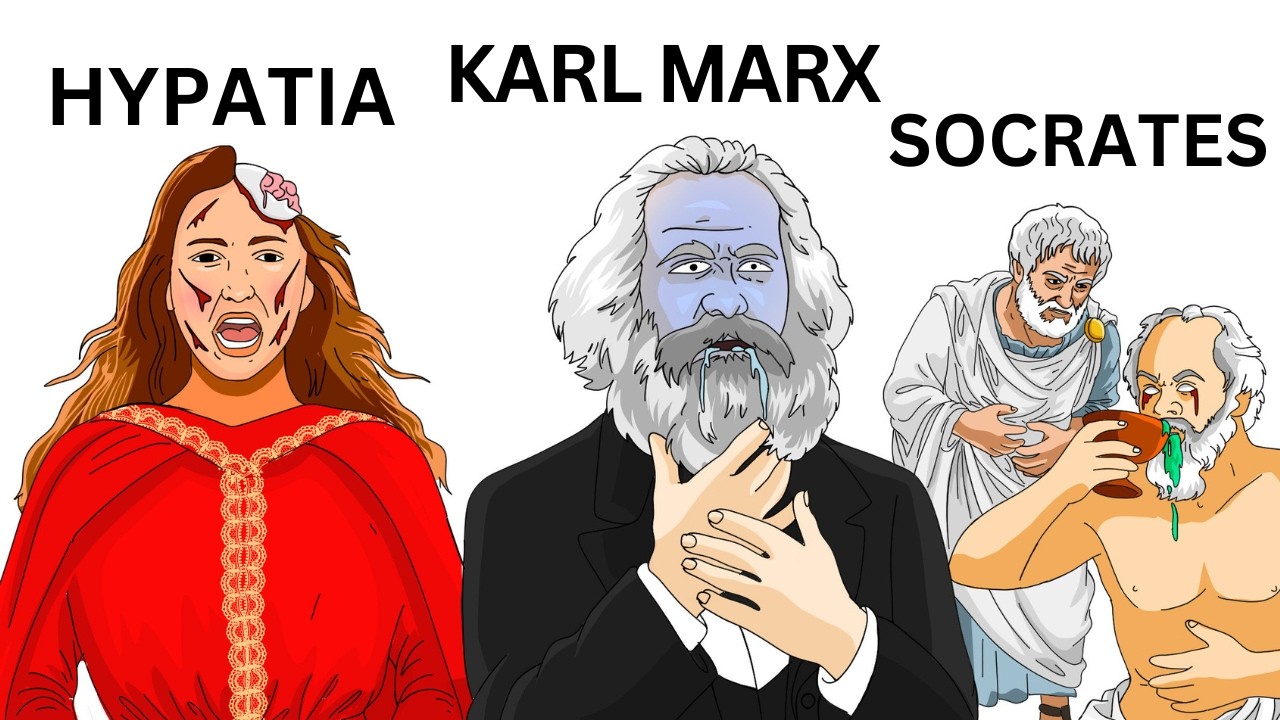
On a day in March 515 AD, she was riding home in her carriage when a fanatical Christian mob surrounded her. They dragged her from the carriage, pulled her into a church, stripped her naked, and beat her viciously. Then they cut her with sharp pieces of pottery, tore her body apart, and burned what remained. The woman who had mapped the stars was erased from the world in a single act of savagery.
Her murder sent shockwaves through Alexandria, but no one was ever punished. Empedocles was a Greek philosopher who believed everything in existence was made from four elements: earth, air, fire, and water. That idea would dominate Western science for two thousand years, adopted by Aristotle and passed down through generations. He also argued that light travels over time instead of instantly, a radical thought for his day.
He was respected everywhere, known as a healer, poet, and politician. But around 430 BC, he became convinced he was more than human. According to legend, he climbed to the top of Mount Etna in Sicily and jumped into the volcano, hoping to prove he was immortal, or even a god. The volcano, however, had other plans.
It later spat back one of his bronze sandals, a grim reminder that he was as mortal as anyone else. Confucius shaped the moral and social foundations of East Asia for over two thousand years. His teachings on ethics, respect for family, social harmony, and proper conduct became the official ideology of the Han Dynasty and beyond, influencing education and government across entire civilizations. But his final years were painful.
He had outlived his son and his favorite disciple, and he felt his ideas had not truly taken hold in the world. Still, he devoted himself to teaching his three thousand students until the very end. He died of natural causes around 479 BC, at the age of seventy-one, and his burial site grew into a cemetery roughly the size of three hundred fifty football fields. Heraclitus believed the universe was always in motion.
Everything flows, he said, and you can never step into the same river twice. He also introduced the concept of the logos, an unchanging truth that governs the constant change. His ideas influenced Plato, Aristotle, the Stoics, and centuries later Hegel and Nietzsche. But his own death was anything but wise.
He developed dropsy, a severe swelling caused by his strict vegetable diet. He went to doctors for help, but spoke to them in riddles, and they couldn’t understand what was wrong. So he decided to cure himself by covering his body in cow dung and lying in the sun, believing the heat would draw out the moisture. The dung hardened around him until he couldn’t move.
He suffocated around 475 BC. Some accounts say wild dogs later tore at his body. Chrysippus was known as the second founder of Stoicism, a man who taught emotional self-control and wrote over seven hundred works on the subject. Even his critics admitted his work was essential to the growth of their own ideas.
But around 206 BC, when he was about seventy-three, he saw a donkey eating his fermented figs. He found it so absurdly funny that he ordered a servant to give the donkey undiluted wine to wash them down. The sight of that donkey drinking wine sent him into such uncontrollable laughter that his body shut down from lack of oxygen. He died shortly after, either from cardiac arrest or asphyxiation, killed by his own joke.
Siddhartha Gautama left a life of wealth and privilege as a prince to become an ascetic, founding a religion that would spread across Asia and beyond for over two thousand five hundred years. His teachings on compassion, ethical living, mindfulness, and the middle way, avoiding both indulgence and extreme austerity, transformed countless lives. He died around age eighty in India, sometime between 483 and 400 BC. According to tradition, after eating a spoiled meal of pork or mushrooms offered by a blacksmith, he fell gravely ill.
As he lay dying, he thanked the host for the food and continued teaching, urging his followers to remember that all things are temporary and to seek liberation through their own effort. Some accounts say his death came from dysentery, others say from pig bell, a severe necrotizing infection of the small intestine. Socrates changed the course of Western philosophy by turning its focus from natural science to ethics, virtue, and the meaning of human life. He developed the method of relentless questioning that still bears his name,) mentored Plato, and shaped centuries of thought.
But his questioning made him dangerous to those in power. He was charged by an Athenian court with impiety, worshipping false gods, and corrupting the youth. During his trial, he angered the jury by suggesting that instead of punishment, he deserved free meals for his contributions to Athens. In 399 BC, at age seventy-one, he was sentenced to death.
His friends offered him a chance to escape, but he refused. He spent his final day in prison, calm, and when the poison made of hemlock was brought, he drank it without hesitation. It paralyzed him from the feet upward until it reached his heart and lungs. According to Plato, his last words were a reminder to repay a small debt: we owe a rooster to Asclepius.
He paid the debt with his life. Plato laid the foundation for Western philosophy, science, and politics. His theory of forms argued that perfect, unchanging concepts exist beyond the physical world, and that everything we see is only an imperfect copy of them. He spent his final years in Athens, writing.
He died around 348 BC, at about eighty. Most accounts say he passed peacefully, either from old age or illness, in his sleep. Some stories claimed he died at a wedding feast; others said he succumbed to a fever while angrily criticizing a Thracian flute girl’s poor sense of rhythm. Even in death, he was thinking about philosophy.
Aristotle studied under Plato, then went on to become one of the most influential minds in history. His work covered metaphysics, ethics, politics, biology, and physics, and he developed formal logic and early systems of classification. He also tutored Alexander the Great. But after Alexander’s death, anti-Macedonian sentiment swept through Athens, and Aristotle, being Macedonian, was accused of impiety.
Rather than suffer the fate of Socrates, he fled the city, saying he would not allow Athens to sin twice against philosophy. He retreated to his mother’s estate on the island of Euboea, where he died in 322 BC, at age sixty-two, from a long-term digestive illness. Augustine of Hippo, born in Roman North Africa, now Algeria, became perhaps the single most important thinker of the Middle Ages. His ideas on original sin, grace, free will, time, and memory shaped Christianity and Western thought permanently.
But in 430 AD, during the Vandal siege of Hippo, he fell ill with a fever. As death approached, he had the Psalms of David written out and hung on his walls, and spent his final days praying and weeping in repentance. He died on August 28th, 430 AD, at age seventy-five. Soon after, the Vandals lifted the siege, but later returned and burned the city, sparing only his cathedral and library.
Thomas Aquinas, an Italian priest, became one of the most influential thinkers in Catholic theology and Western philosophy. He merged Aristotle’s ideas with Christian belief, developed his famous five ways arguments for the existence of God, and shaped virtue ethics. In 1274, he was traveling on a donkey to the Second Council of Lyon when he struck his head hard on an overhanging branch. The impact caused a slow accumulation of blood between his brain and skull.
Over several weeks, headaches, confusion, and weakness worsened despite the care of monks in a monastery. He died on March 7th, 1274, at age forty-eight, while commenting on a poem, killed by the effects of that head injury. Ibn Sina, known in the West as Avicenna, was a Persian philosopher and physician who worked in Iranian royal courts, becoming one of the most influential figures in both Islamic and European thought. He was often called the father of early modern medicine, famous for his encyclopedias, The Book of Healing and The Canon of Medicine.
He suffered from recurrent colic throughout his life, but he never stopped working. In 1037, while accompanying a prince on campaign, a painful attack struck. Despite being a master physician, he treated himself aggressively, including administering eight enemas to himself in a single day. This caused serious intestinal damage.
Some accounts say a servant later added excess opium to his medicine, either by accident or on purpose. He died on June 22nd, 1037, at age fifty-seven, in Hamadan. Francis Bacon, the English philosopher known as the father of empiricism, argued that knowledge must come from observation and experimentation, not ancient logic. His ideas helped ignite the scientific revolution.
But in April 1626, while traveling through snow near Highgate outside London, he decided to test whether meat could be preserved with snow. He bought a hen and stuffed snow inside it. The cold exposure made him seriously ill. Unable to return home, he was taken to a friend’s country house, where they placed him in a damp bed, which only made things worse.
He died on April 9th, 1626, at age sixty-five, from pneumonia, essentially killed by his own scientific curiosity. René Descartes,a Frenchman, became known as the father of modern philosophy. He rejected reliance on past philosophers, promoted rationalism, introduced coordinate geometry, and helped shape the scientific revolution. His famous idea, I think, therefore I am, and his view separating mind from body influenced philosophy and psychology for centuries.
In 1649, hoping to escape controversy, he moved to Sweden at the invitation of Queen Christina. But she demanded her philosophy lessons at five in the morning, in a cold, drafty castle. He fell ill on February 1st, 1650, and after about ten days, died on February 11th, at age fifty-three, likely from pneumonia. Another theory claimed he was poisoned with an arsenic-laced communion wafer by a priest who wanted to prevent him from influencing the queen.
Kurt Gödel was an Austro-Hungarian logician, considered one of the most important thinkers since Aristotle. His 1931 incompleteness theorems revolutionized mathematics and philosophy, creating profound implications even for artificial intelligence. But in later life, he struggled with mental instability. After one of his friends was murdered, he became paranoid that he, too, would be poisoned.
He would only eat food prepared by his wife. When she was hospitalized for six months, he refused to eat at all. He died on February 14th, 1978, in Princeton Hospital, New Jersey, weighing just twenty-nine kilograms. He was seventy-one.
Karl Marx was a German philosopher whose ideas formed the basis of communism, influencing the creation of states like the Soviet Union and China. His critique of capitalism, especially the Communist Manifesto, shaped socialist thought worldwide. After his wife’s death in 1881, he caught chronic airway inflammation, which led to bronchitis and lung inflammation. He struggled to breathe and had constant, sharp, stabbing chest pain.
He died in London on March 14th, 1883, at age sixty-four, poor and stateless. Friedrich Nietzsche was a German philosopher famous for declaring that God is dead, meaning the decline of traditional Christian values. He introduced concepts like the Übermensch, the will to power, and emphasized individual meaning and responsibility. He criticized Western morality, arguing that it limited human potential.
In 1889, at age forty-four, he had a mental breakdown. Reportedly, after witnessing a horse being beaten in Turin, Italy, he threw his arms around its neck to protect it, then collapsed. In the following days, he wrote bizarre letters claiming he had created the world, ordering the Pope to be jailed, and demanding that the German emperor and all anti-Semites be shot. He spent the next eleven years in a state of paralysis and dementia under family care.
He died on August 25th, 1900, at age fifty-five, from pneumonia and a stroke. John Locke, an Englishman, became known as the father of liberalism. His ideas on liberty, property, and the legitimacy of state authority shaped modern democracy, influencing the American Revolution and the Declaration of Independence. He also argued that people have the right to remove unjust rulers.
In his final years, he lived quietly as a guest at his friend’s manor in the countryside, where the cleaner air helped with his chronic asthma. But the attacks grew more severe. On October 28th, 1704, at age seventy-two, he died peacefully in his room. David Hume, a Scottish philosopher, used empiricist and skeptical thinking to shape modern thought, influencing Immanuel Kant, Adam Smith, and Charles Darwin.
He died in Edinburgh at age sixty-five from abdominal cancer, calmly saying that belief in an afterlife was unreasonable. Jean-Jacques Rousseau, a Swiss philosopher, argued that humans are naturally good but corrupted by society. He believed legitimate government comes from the general will of the people, an idea that influenced democratic thought and fuel the French Revolution. He also promoted educationthat develops a child’s natural abilities and emphasized emotion and authenticity.
But many people hated his views, so he spent much of his life as a fugitive. In 1776, in Paris, he was knocked down by a nobleman’s carriage and a Great Dane dog, suffering a concussion that later caused neurological damage and seizures. His health declined afterward. In 1778, he moved to a cottage in the castle of one of his students.
On July 1st, he had a large meal with his host’s family. The next morning, as he was about to go teach music, he suddenly died from a brain hemorrhage caused by a stroke. He was sixty-six. Immanuel Kant, a German philosopher, created a new era in philosophy.
His moral theory, the categorical imperative, argued that people should only act in ways they would want everyone else to follow. He shaped modern ethics, metaphysics, and political thought. In his Critique of Pure Reason, he argued that we do not see reality as it truly is, only how our minds interpret it. In his final years, speech problems and dementia weakened him.
He became frail, suffered falls, and lost his appetite. He died on February 12th, 1804, in Königsberg, at age seventy-nine, saying, Es ist gut. Ludwig Wittgenstein, an Austrian philosopher, transformed how philosophy understands language, meaning, and logic, with lasting impact on psychology and social theory. By 1949, during a trip to Ithaca, New York, he was already unwell with anemia.
He was later diagnosed with inoperable prostate cancer that had spread. Knowing he had little time left, he continued writing and working until the very end. He spent his final days at his doctor’s home in Cambridge, refusing to go to a hospital.
On April 28th, 1951, at the age of sixty-two, he became critically ill,and died shortly after telling his doctor’s wife, Tell them I’ve had a wonderful life.