The Movie Star Who Secretly Helped Invent Wi-Fi — Hedy Lamarr | Learn English Through Stories ✅
Hello, my friends. Welcome back to story time English. I am so grateful you are here with me today.
 Take a deep breath, let your shoulders drop, and let me tell you a story that I think will surprise you.
Did you know that the technology behind your Wi-Fi, your Bluetooth, and your mobile phone can be traced back to a Hollywood movie star? Not a scientist, not an engineer, a movie star. A woman who was once called the most beautiful woman in the world.
She walked the red carpets. She kissed leading men on the silver screen. And in her spare time, at her kitchen table, she invented a technology that would help win a war and eventually change the way the entire world communicates.
Nobody believed her. Nobody took her seriously. They looked at her face and saw only beauty.
They never saw the mind behind it. Her name was Hedy Lamarr. And this is her story.
She was born Hedwig Eva Maria Kiesler on the 9th of November, 1914, in Vienna, Austria. Her father, Emil, was a successful bank director. Her mother, Gertrude, was a talented pianist.
The family was Jewish, cultured, and comfortable. They lived in a beautiful apartment in one of the finest neighborhoods in the city.
From the beginning, Hedwig was extraordinary. She was beautiful, yes. Even as a child, people stopped to look at her.
But she was also fiercely curious. Her father loved to take her on long walks through Vienna. He would explain how things worked, how the street cars moved, how electricity traveled through wires, how the engines in the factories turned raw materials into finished products.
Hedwig listened to every word. She asked question after question. She wanted to understand the world, not just look at it.
At the age of five, she took apart a music box to see how it made its sounds. She laid out every tiny gear and spring on the carpet, studying each piece carefully. Then, she put it all back together.
It still worked. Her parents looked at each other. This was not an ordinary child.
She was a good student, especially in science. She loved learning how machines worked. She loved understanding the logic behind things.
But, she was also drawn to beauty, to 𝒹𝓇𝒶𝓂𝒶, to performance. There were two sides to Hedwig from the very beginning. The engineer and the actress.
The thinker and the dreamer. The world would only ever want to see one of them.
As a teenager, Hedwig became interested in acting. She was drawn to the stage. She began appearing in plays, and then in films.
In 1933, at just 18 years old, she starred in a film that caused a 𝒔𝒄𝒂𝓃𝒹𝒶𝓁 across Europe. The film was controversial, and Hedwig became famous overnight. But, it was not the kind of fame her family had hoped for.
Something was coming that would change the direction of her life completely.
In 1933, at the age of 19, Hedwig married Friedrich Mandl, one of the richest men in Austria. Mandl was a powerful arms dealer who sold weapons and ammunition to governments around the world, including to fascist leaders in Italy and Germany. He was wealthy beyond imagination.
But, he was also controlling and deeply possessive. He did not want his young wife to act in films. He did not want her to have a career.
He wanted her at his side, beautiful and silent, a decoration at his dinner table.
 But, those dinner tables were very interesting. Mandel entertained generals, politicians, and weapons experts from across Europe. They discussed military technology openly.
They talked about torpedoes, about radio signals, about how weapons were guided to their targets. Hedwig sat quietly and listened. The men assumed she did not understand.
They were wrong. She understood everything. And she remembered it all.
Hedwig was miserable in her marriage. Mandel watched her constantly. He controlled where she went, who she spoke to, what she wore.
She later described the marriage as a kind of prison. She knew she had to escape, and escape she did. The details are not entirely clear.
Some say she drugged a maid who was guarding her and slipped out of the house in the middle of the night. Some say she simply walked out during a dinner party. What is certain is that Hedwig fled Austria.
She traveled to London. And there, in a hotel lobby, she met one of the most powerful men in Hollywood, Louis B. Mayer, the head of MGM Studios.
Mayer offered her a contract, but there was a condition. She needed a new name. Hedwig Kiesler would not work for American audiences.
Mayer renamed her Hedy Lamarr, after a famous silent film star named Barbara Lamarr. And just like that, a new identity was born.
Hedy Lamarr arrived in Hollywood in 1938 and quickly became one of the biggest stars of the era. Her first American film made her famous overnight. She was stunning on screen.
Audiences could not take their eyes off her. The press called her the most beautiful woman in the world. She starred in film after film alongside the biggest names in Hollywood.
She was glamorous, elegant, and admired. Photographers followed her everywhere.
But Hedy was bored. The roles they gave her were shallow. She stood in beautiful dresses and delivered simple lines.
Nobody asked her to think. Nobody asked her opinion about anything beyond her wardrobe. In interviews, reporters asked about her hair, her clothes, her beauty secrets.
Nobody asked about her ideas, she once said. Any girl can be glamorous. All she has to do is stand still and look stupid.
Behind the beauty, behind the makeup and the studio lights, there was a restless, brilliant mind that Hollywood never bothered to notice. Can you imagine what that felt like? Being famous for something you did not choose.
Your face. While the thing you were truly proud of, your mind, was invisible to the world. The studio wanted her to be beautiful.
She wanted to be brilliant. The world gave her fame for one and silence for the other.
But Hedy refused to let her mind sit idle. At night, after the cameras stopped and the studio lights went dark, she went home and worked at a table covered with sketches and diagrams. She set up a room in her house that she called her invention room.
She designed improvements to traffic lights. She created a tablet that dissolved in water to make an instant soft drink, a kind of early version of flavored water. She was always thinking, always designing, always solving problems.
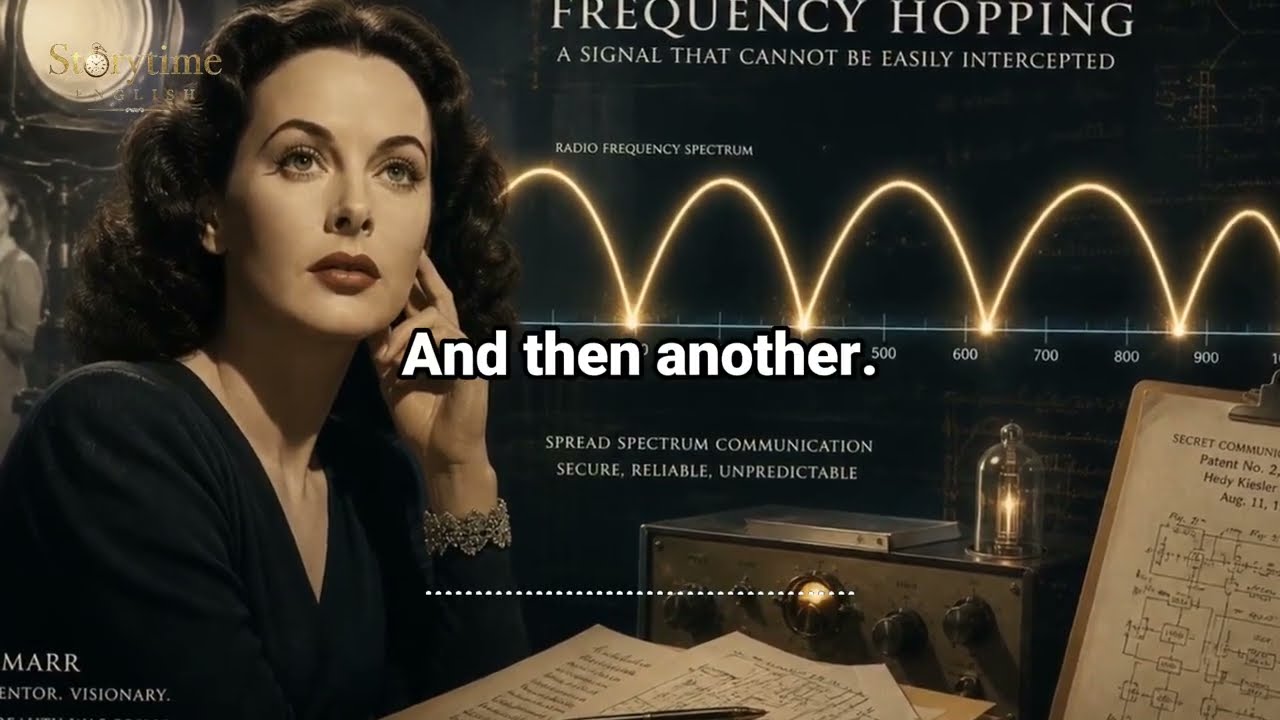 And then the Second World War began. Across the Atlantic, the world Hedy had fled from was burning. And her two worlds, Hollywood and technology, came together in a way nobody expected.
Hedy was horrified by the war. German submarines were sinking Allied supply ships in the Atlantic. Thousands of sailors were dying in the cold water.
She had fled from Austria just ahead of the Nazis. She knew what was happening in Europe. She wanted to help.
And she had an idea, a dangerous, ambitious, brilliant idea born from those dinner table conversations she had overheard years ago in Friedrich Mandl’s house. The problem was this. The Allied forces were using radio-controlled torpedoes to attack enemy ships.
But the enemy could easily jam the radio signal. Jamming means sending out a strong interfering signal on the same frequency, which confuses the torpedo and makes it miss its target. If the torpedo’s radio signal stayed on one frequency, the enemy could find it and block it.
Hedy thought back to those dinner table conversations in Mandl’s mansion. She remembered the discussions about radio-guided weapons. She remembered the problem of jamming, and she came up with a solution that was elegant in its simplicity.
What if the radio signal did not stay on one frequency? What if it jumped rapidly from one frequency to another in a pattern that only the sender and the receiver knew? The enemy would try to jam the signal.
But by the time they found one frequency, the signal had already jumped to another. And then, another. And then, another.
It would be like trying to follow a conversation in a crowded room where the speakers kept changing seats.
She called this idea frequency hopping, but she needed help with the technical details. She found it in an unlikely place. George Antheil was a composer, a musician known for wild experimental concerts.
He had once created a piece of music that used 16 player pianos, all synchronized together. Hedy realized that his knowledge of synchronizing mechanical instruments could solve the problem of synchronizing the frequency jumps between the torpedo and the ship.
Together, they worked at Hedy’s kitchen table in the evenings after her film shoots. During the day, she was a movie star, smiling under bright lights and reading her lines. At night, she was an inventor, bent over papers and pencils, solving problems that trained engineers had not solved.
They sketched diagrams. They tested ideas. They argued and refined their design over many months.
Antheil designed a mechanism using a roll of punched paper, similar to the rolls used in player pianos, to synchronize the frequency changes between the torpedo and the ship. It was a mechanical system, simple and elegant.
They filed a patent on the 11th of August, 1942. Patent number 2,292,387. It was officially registered under the name Hedy Kiesler Markey, her married name at the time.
The patent described a secret communication system using frequency hopping across 88 frequencies, the same number as the keys on a piano. It was brilliant.
The United States Navy rejected it. Think about that for a moment. A system that could have saved ships and lives, rejected.
The Navy told Hedy that if she wanted to help the war effort, she should use her famous face to sell war bonds instead. And she did. She raised millions of dollars for the war effort.
At one war bond event alone, she helped raise $7 million in a single evening. She smiled for the cameras. She did her duty with grace and patriotism.
But inside, she knew that the world dismissed her mind because of her beauty. People could not believe that a movie star could also be an inventor.
 The patent expired in 1959 without Hedy receiving a single dollar for it. But the technology did not die. In the 1960s, the Navy finally adopted a version of frequency hopping for secure military communications.
And over the following decades, the same basic principle, spreading a signal across multiple frequencies, became the foundation for technologies that you and I use every single day. Wi-Fi, Bluetooth, GPS, modern cellular networks. Every time you connect to Wi-Fi, you are using her technology.
Every time you send a message from your phone, her invention is working. It all goes back to a movie star and a composer at a kitchen table during a World War.
Hedy Lamarr’s later years were not happy. Her film career faded as she grew older. Hollywood had no use for an aging beauty.
She married six times, searching for a connection she never quite found. She became increasingly isolated, spending more and more time alone in her apartment. She had financial difficulties.
She was arrested twice for shoplifting in stores, charges that were later dropped. The incidents made headlines. The press, which had once celebrated her beauty, now mocked her troubles.
The world remembered her face and forgot everything else.
Recognition came very late. In 1997, at the age of 83, Hedy and George Antheil were given the Electronic Frontier Foundation Pioneer Award for their invention. When she was told about the award by telephone, she reportedly said, “Well, it’s about time.”
Hedy Lamarr died on the 19th of January, 2000, in Florida. She was 85 years old. In 2014, she was inducted into the National Inventors Hall of Fame.
Today, her contribution to technology is finally recognized by scientists and engineers around the world. There is a Hedy Lamarr Day, celebrated on the 9th of November, her birthday. The woman they called the most beautiful woman in the world turned out to be one of the most important inventors of the 20th century.
Beauty fades from photographs, but her invention is alive in every wireless device on Earth.
And so, my friend, the story of the girl from Vienna comes gently to its end. Think about what we have discovered together. A woman who was seen but not heard.
A mind that was hidden behind a face. An invention that was rejected, forgotten, and then, decades later, became part of everyday life for billions of people. She did not fit the world’s expectations.
She was a movie star who wanted to be an inventor. She was a glamorous woman who wanted to talk about torpedoes and radio signals, and the world did not know how to handle that.
And you, my friend, maybe you understand something about being more than what people see. Maybe when you speak English, people hear your accent and make assumptions. Maybe they do not see the effort behind every sentence, the hours of listening, the patience, the courage it takes to speak in a language that is not your own.
Maybe sometimes you feel like the world sees only the surface and misses what is underneath.
But remember, Hedy, her invention was invisible for decades, but it was real. It was powerful. And in the end, it changed the world.
Your effort is real, too. Every word you learn, every story you understand, is a signal jumping to a new frequency. You are building something that the world may not see yet, but it is there.
And one day, it will be impossible to ignore. Keep inventing yourself, my friend. Keep learning, and never let anyone tell you what you are capable of.
This is Storytime English. Until next time, my friends. Take care of yourselves, and never stop learning.