Hello my friends. Welcome back to Storytime English. I am so glad you are here with me today.
Take a slow, deep breath. Let your shoulders relax. And let this story remind you that the most powerful weapon in the world is not a gun, not a sword, not an army.
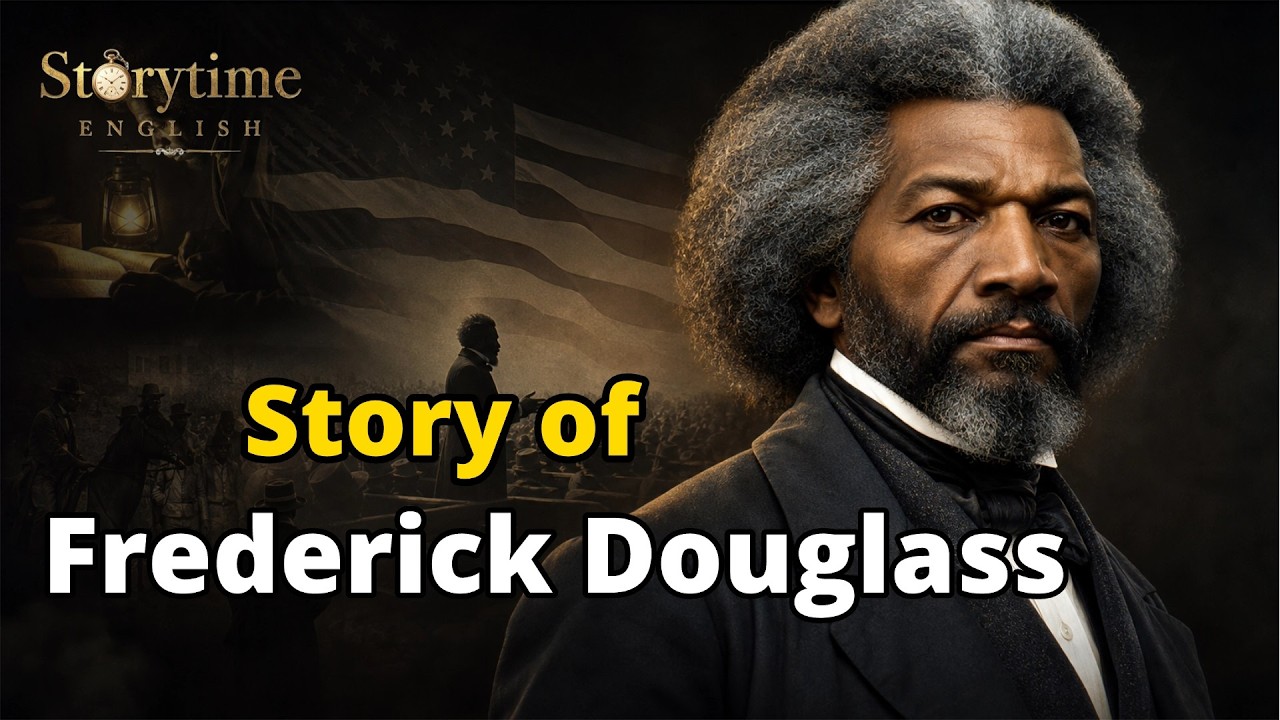 It is a word.
Now, imagine you are a child. You are about eight years old. You are a slave.
You do not know your birthday. You have never seen your father. Your mother was taken away from you when you were a baby.
You sleep on the dirt floor of a kitchen. You own nothing, not even yourself.
One day, the woman of the house begins to teach you the alphabet. A, B, C, D. You learn quickly.
Your mind is fast. For the first time in your life, something inside you wakes up. You feel a door beginning to open.
And then, her husband walks in. He sees what she is doing, and his face turns red with anger. He shouts, “Stop!
If you teach that boy to read, he will become unfit to be a slave. He will want to be free. Reading will ruin the best slave in the world.”
The woman stops. She never teaches you again. But you heard what the man said.
And his words did not discourage you. They told you something he did not mean to say. They told you the secret.
Reading is the path from slavery to freedom. From that day on, you will do anything to learn to read. Anything.
That boy was Frederick Douglass. And the words he learned in secret would one day shake a nation awake. Stay with me, because this is the story of a man who turned stolen letters into the most powerful voice in America.
Frederick was born in February of 1818 on a plantation on the Eastern Shore of Maryland. He was born into slavery. His mother’s name was Harriet Bailey.
She was enslaved on a different plantation several miles away. Frederick almost never saw her.
She would sometimes walk twelve miles through the night to lie beside him while he slept and then walk back before sunrise so she would not be punished for being away. She died when Frederick was about seven years old. He was not allowed to see her when she was sick.
He was not allowed to go to her funeral.
Frederick never knew exactly who his father was. He believed his father was a white man, possibly the man who owned him. This was common in slavery.
Enslaved women had no power to refuse. No one spoke of it openly. It was one of the many silent horrors of the system.
As a small child, Frederick lived on a plantation run by a cruel overseer. The children were fed like animals. Cornmeal mush was poured into a wooden trough on the ground and the children ate with their hands or with oyster shells like dogs.
They had no shoes, no beds, and almost no clothing. In winter, Frederick’s feet cracked and bled from the cold. He was always hungry.
He was always cold.
When Frederick was about eight years old, he was sent to Baltimore to live with a family called the Aulds. Hugh Auld worked in the shipyards. His wife, Sophia, had never owned a slave before.
She was kind at first. She treated Frederick almost like a human being and she began to teach him the alphabet.
That was the moment that changed everything.
When Hugh Auld discovered what his wife was doing, he stopped her immediately. He said those words that Frederick would never forget: that reading would make a slave unfit to be a slave, that reading would make him want freedom. Hugh Auld meant it as a warning.
Frederick received it as a gift.
 That one sentence, spoken by a slaveholder, had accidentally revealed the greatest secret of slavery. The entire system depended on keeping black people ignorant. Knowledge was the key to the cage.
And now, Frederick knew where the key was hidden.
From that moment, Frederick became obsessed with learning to read. But how? Sophia Auld, once kind, now became harsh.
She had been told that teaching a slave was dangerous, and she believed it. If she saw Frederick near a newspaper, she snatched it from his hands. She watched him constantly.
So Frederick found another way. He made friends with white boys in the streets of Baltimore. These were poor boys, hungry boys, boys who had bread but no books.
Frederick had bread from the Auld kitchen. He traded it. A piece of bread for a reading lesson.
He would meet a boy on the street, give him food, and the boy would teach him a few words, a few sentences, a few pages. Think about that. A child trading food, food he needed to survive for the chance to learn a word.
That is how much reading meant to him. He was buying his own freedom one letter at a time.
He found a book called The Columbian Orator. It was a collection of famous speeches about freedom, justice, and human rights. Frederick read it again and again until the pages nearly fell apart.
The words set his mind on fire.
He read speeches by people who argued that slavery was wrong, that every human being was born free, that no person had the right to own another person. These ideas entered his blood. They became part of him.
He could never unread them. He could never unknow what he now knew.
But knowledge brought pain. Frederick later wrote that learning to read had been both a blessing and a curse. Before he could read, he did not fully understand how terrible slavery was.
He suffered, but he did not have the words to describe his suffering. Now he did.
Now he understood exactly what had been stolen from him: his name, his family, his freedom, his humanity. He could see the cage clearly, and seeing it clearly made the pain almost unbearable. He wrote, “I would at times feel that learning to read had been a curse rather than a blessing.
It had given me a view of my wretched condition without the remedy.”
But Frederick did not let the pain destroy him. He let it fuel him.
When Frederick was about fifteen, he was sent back to the countryside to work on a farm. His new master, a man named Thomas Auld, thought Frederick had become too proud, too independent, too dangerous. So Thomas sent him to a man named Edward Covey, a farmer known throughout the region as the slave breaker.
Covey’s job was to crush the spirit of difficult slaves through constant work and brutal beatings. For nearly a year, Covey broke Frederick down. He beat him every week.
He worked him from before sunrise to after sunset. Frederick was whipped, kicked, and starved.
He later said that Covey succeeded for a time. Frederick’s spirit was crushed. He stopped reading.
He stopped thinking about freedom. He became what Covey wanted: a broken man who worked in silence.
But one hot August day, something snapped. Covey came at Frederick to beat him again, and this time, Frederick fought back. He grabbed Covey by the throat.
The two men fought for nearly two hours. Frederick did not punch Covey. He simply held him, blocked his blows, and refused to submit.
He would not lie down. He would not cry. He would not beg.
 Covey never beat Frederick again. Frederick later called that moment the turning point of his life. He wrote, “However long I might remain a slave in form, the day had passed forever when I could be a slave in fact.”
His body was still enslaved, but his mind was free. And a free mind, Frederick knew, was something no chain could hold.
Frederick began planning his escape. His first attempt failed. He was caught, thrown in jail, and nearly sold to the deep south.
But he was sent back to Baltimore, where he learned a trade caulking ships in the shipyards. He saved money. He waited.
He planned again.
On the 3rd of September, 1838, Frederick put his plan into action. He dressed in a red sailor’s shirt and a sailor’s hat. He borrowed identification papers, a document called a seaman’s protection certificate, from a free black sailor he knew.
The description on the paper did not match Frederick well. If anyone looked closely, they would see the difference.
He boarded a train heading north. His heart was pounding. He sat among other passengers trying to look calm while his blood raced with terror.
A conductor came through the car checking papers. Frederick held out his certificate. The conductor glanced at it.
He looked at Frederick.
A moment passed, a moment that felt like a lifetime. Then the conductor moved on. He had not looked carefully enough.
Frederick was still free—for now.
The train crossed into the free state of Pennsylvania, then into New York. Frederick stepped off and stood on free soil. He was twenty years old.
He was free.
He later wrote about that moment. He said the world looked different. The air tasted different.
He felt like a man who had escaped from a den of hungry lions. The joy was enormous, but so was the fear. He was a runaway slave in a country where slave catchers hunted men like him for money.
Frederick settled in New Bedford, Massachusetts with his new wife, Anna Murray, a free black woman who had helped him plan his escape. He changed his name from Frederick Bailey to Frederick Douglass to make it harder for slave catchers to find him. He took the name from a character in a poem by Sir Walter Scott.
And then Frederick Douglass began to speak.
In 1841 he attended a meeting of abolitionists, people who wanted to end slavery. Someone asked him to stand up and tell his story. He was nervous.
He had never spoken in front of a large crowd. But he stood. And he began to talk about his life as a slave.
The audience was stunned. Here was a man who had been born in chains, who had taught himself to read from stolen bread and borrowed books, who had fought a slave breaker with his bare hands, and he spoke with a power and eloquence that most educated men could never match. His voice was deep and commanding.
His language was precise and beautiful. His arguments were devastating. People wept as they listened.
Frederick Douglass became the most powerful voice against slavery in America. He traveled across the country from church halls to town squares, speaking to thousands. People came from miles away to hear him.
He spoke for two hours at a time without notes, holding audiences in silence.
His presence on the stage was extraordinary. He was tall, broad, and dignified with a great mane of hair and a voice that could fill any room. He could make an audience laugh one moment and weep the next.
 But it was dangerous work. Pro-slavery mobs attacked his meetings. He was beaten and thrown out of trains for sitting in seats reserved for white passengers.
In Indiana, a mob broke his hand. He carried it in a splint and kept speaking the next day.
In 1845, he published his autobiography, Narrative of the Life of Frederick Douglass, an American Slave. It became one of the most important books in American history. He wrote with such power and clarity that some white readers refused to believe it.
They said no former slave could write this well. That doubt was itself proof of the prejudice he was fighting against.
The book was translated into many languages and sold tens of thousands of copies. But publishing it was also dangerous. By telling his real story, Frederick had revealed his identity to his former owner, who could legally reclaim him.
To stay safe, Frederick traveled to Britain and Ireland, where enormous crowds came to hear him speak.
British supporters raised money to buy his legal freedom, and in 1846, Frederick Douglass became a free man under the law—not just in practice, but on paper.
He returned to America and started his own newspaper. He called it The North Star, after the star that guided runaway slaves to freedom. His words were weapons.
He did not fight slavery with guns. He fought it with sentences. He took the language of the country that had enslaved him and turned it against the system that had tried to keep him silent.
When the Civil War came in 1861, Douglass pushed President Abraham Lincoln to let black men fight for the Union Army. Lincoln listened. Nearly 200,000 black soldiers served in the war.
Douglass’s own sons were among them.
After the war ended and slavery was abolished, Douglass continued to fight for voting rights, for equal treatment under the law, for the rights of women. He served as a United States Marshal, as Recorder of Deeds for Washington, D. C.
, and as the American Minister to Haiti. A man who had been born as property became one of the most respected public figures in the nation.
Frederick Douglass died on the 20th of February, 1895, at the age of 77. On the morning of his death, he had attended a women’s rights meeting. He came home, stood in the hallway of his house, and collapsed.
He died as he had lived: still fighting, still speaking, still standing up.
And so, my friend, the story of Frederick Douglass comes gently to its close. He was the boy who was not allowed to know his own birthday. He was the child who traded bread for letters.
He was the young man who grabbed a slave breaker by the throat and said, “No more.” He was the voice that helped tear slavery apart, not with violence, but with words.
And you, my friend, are doing right now what Frederick Douglass risked his life to do. You are learning to read. You are learning a language.
You are picking up words, one by one, and building something powerful with them: a new way to think, a new way to speak, a new way to be heard.
Frederick Douglass once said, “Once you learn to read, you will be forever free.” He meant it. Words set his mind free long before his body was free.
And every word you learn sets you a little freer, too.
So keep reading, my friend. Keep learning. Keep trading your time and effort for one more word, one more sentence, one more idea.
Because words are the most powerful thing in the world, and no one can ever take them away from you.
This is Storytime English. Tell me, my friend, what part of Frederick’s story hit you the hardest? Was it the bread he traded for letters, the fight with Covey, or the moment he stepped onto free soil?
I would love to hear your thoughts in the comments below.
There are many more stories waiting right here, and I will be here when you come back. Until next time, take care of yourself, and never stop learning.


