# Her Photo Was Stolen — She Never Got the Credit — Rosalind Franklin | Learn English ✅
Welcome back to Storytime English. I am so glad you are here with me today. Let us take a slow breath together.
 Find a comfortable place. And let me tell you a story about a photograph, a discovery, and a woman the world forgot.
Did you know that one single photograph changed the entire course of biology? Not a photograph of a person or a place. A photograph of something so small that no human eye could ever see it.
A photograph of the building blocks of life itself.
The woman who took that photograph, her careful, brilliant work made one of the greatest discoveries in science possible. But she was never given the credit she deserved. Her name was Rosalind Franklin.
This is her story.
Rosalind Elsie Franklin was born on the 25th of July, 1920, in Notting Hill, London. Her family was wealthy, educated, and Jewish. Her father, Elies, was a banker who also taught evening classes for working people.
Her mother, Muriel, was active in charity work. The family valued education, hard work, and service to others.
From the very beginning, Rosalind was different. She was sharp, precise, and intensely focused. While other children played games, Rosalind asked questions.
She wanted to know how things worked. She wanted to understand the rules behind the world she could see.
Her aunt later remembered that even as a child, Rosalind did not accept easy answers. She wanted proof. She wanted evidence.
She wanted to see things for herself.
The Franklin family had lively conversations around the dinner table. They discussed politics, ideas, and the events of the day. Young Rosalind loved these conversations.
She joined in early. She argued her points clearly and firmly, even when she disagreed with the adults.
Her father once said with a mix of pride and exhaustion that Rosalind would argue about anything. This was not stubbornness for its own sake. It was a deep need for clarity and truth.
She could not simply accept something because someone in authority said it was true. She needed to understand the reasoning behind it.
Rosalind attended one of the best schools for girls in London. She excelled in science and mathematics. She was precise in everything she did.
Her notes were perfect. Her experiments were careful. At the age of fifteen, she already knew what she wanted to be.
She wanted to be a scientist.
Her father was not enthusiastic about this dream. In the 1930s and 1940s, science was widely considered a man’s world. Women were often discouraged from pursuing careers in research.
Many universities and laboratories simply would not accept them. He wanted his daughter to choose a more practical career, perhaps social work or teaching.
But Rosalind was determined. She would not be turned away. She had a clear vision of her future, and she would not let the expectations of society stop her.
In 1938, she entered Cambridge University, one of the most respected universities in the world. She studied chemistry. She worked with intense dedication, often spending long hours in the laboratory.
Her professors noticed her talent, especially her remarkable attention to detail.
She graduated in 1941, during the Second World War. The world was in chaos, but science was needed more than ever. She immediately began research that would help the war effort.
She studied the properties of coal and carbon. Her work helped improve gas masks and other materials used to protect soldiers.
Her research on coal was detailed and original. She discovered things about the internal structure of coal that nobody had found before. She looked at the tiny, invisible structures within coal and found patterns that no one else had seen.
Her work helped classify different types of coal based on these tiny structures.
It was practical science that had real applications in industry and in the war. And it was so impressive that it earned her a doctoral degree, the highest academic qualification a scientist can receive. By the age of twenty-six, Rosalind Franklin was Doctor Franklin.
She became an expert in a technique called X-ray crystallography. This is a method of using X-rays to create images of the internal structure of tiny things, like molecules. Molecules are the basic building blocks of all matter.
They are so small that no ordinary microscope can show their shape.
 X-rays are a type of invisible light that can pass through solid objects. When X-rays hit a crystal, they scatter in patterns that reveal the shape of the molecules inside. Think of it this way.
Imagine you cannot open a box, but you can shine a special light through it. The way the light bends and scatters on the other side tells you the shape of what is inside.
That is what X-ray crystallography does. And Rosalind Franklin was one of the best in the world at reading those patterns.
In 1947, she moved to Paris to work at a research laboratory. She loved Paris. She loved the food, the culture, the freedom.
She made many friends. She was happy.
Her colleagues described her as lively, warm, and generous. She laughed easily and loved good conversation. She was not the cold, difficult person that some would later describe.
She was passionate about her work and about life.
This is important to remember because the story that was later told about Rosalind Franklin painted a very different picture. The world would come to know her through the unkind words of her competitors, not through the eyes of her friends.
But something was calling her back to England. In 1951, she accepted a position at King’s College London, one of the oldest universities in the country. She was hired to work on a specific problem, the structure of DNA.
DNA, which stands for deoxy ribonucleic acid, is the molecule that carries the instructions for life. It is inside every cell of your body. It tells your cells how to grow, how to work, how to make you who you are.
In the early 1950s, scientists knew that DNA was important. But nobody knew what it looked like. Nobody knew its shape.
And without understanding the shape, they could not understand how it worked. This was one of the biggest questions in science.
Scientists around the world were racing to solve it. Whoever discovered the structure of DNA first would make history. And Rosalind Franklin was brought to King’s College to help answer the question.
But from the very first day she arrived, things went wrong. There was a misunderstanding about her role. Another scientist at King’s College, a man named Maurice Wilins, was already working on DNA.
He expected Rosalind to work as his assistant.
But Rosalind was told that the DNA project was hers to lead independently. The two scientists had different expectations, and they clashed. Wilins was quiet and indirect.
Franklin was direct and precise. Wilins expected collaboration. Franklin expected independence.
The tension between them grew. It did not help that King’s College was a deeply traditional place. There was a common room where men gathered for lunch and discussion.
Women were not allowed in. Rosalind ate her meals alone in a separate dining area.
Despite the difficult environment, Rosalind threw herself into her work. She did not complain about the common room or the dining table. She simply worked.
And her work was extraordinary.
She spent months carefully preparing DNA samples for X-ray analysis. This was delicate, painstaking work. The DNA fibers had to be stretched and aligned perfectly.
The humidity in the room had to be controlled precisely. The X-ray beam had to be focused exactly right.
She refined her techniques over many months. She adjusted her equipment piece by piece. She was patient and meticulous, which means extremely careful about every small detail.
Other scientists rushed. Rosalind did not rush. She believed that careful work produced true results and careless work produced lies.
She would rather take longer and be certain than hurry and be wrong.
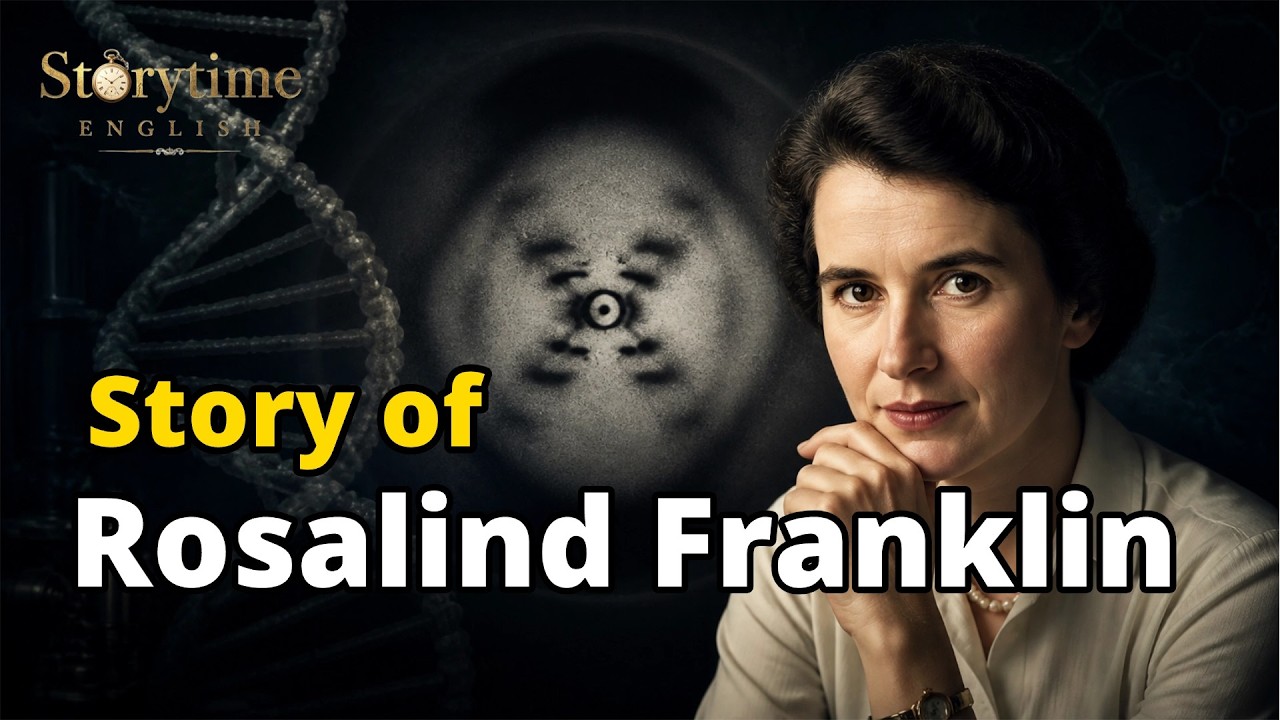
In May 1952, she took a photograph that would change the history of science. It was called photo 51. The image showed an X-shaped pattern of dark spots and lines.
To most people, it would look like nothing. Just a blurry arrangement of marks on a piece of film.
But to a trained crystalographer, it screamed one thing. The DNA molecule was shaped like a helix. A spiral.
 Like a twisted ladder.
Can you imagine how remarkable that is? A single photograph taken in a dark basement laboratory revealing the shape of the molecule that carries the secret of life.
Rosalind studied the photograph carefully. She began making detailed mathematical calculations based on the patterns she saw. She measured angles.
She measured distances between the spots. She was getting closer and closer to solving the structure.
But Rosalind was careful. She did not rush to announce her findings. She wanted more data.
She wanted to be absolutely certain before she published her results. This was how she had always worked. Other scientists might guess and then check later.
Rosalind checked first and only spoke when she was sure.
She continued her calculations, her measurements, her analysis. She was building the case piece by piece.
But something happened that she did not know about. In January 1953, Maurice Wilins showed photo 51 to another scientist. This was a young American named James Watson, who was working at Cambridge University with a British physicist named Francis Crick.
Watson and Cick were also trying to discover the structure of DNA. But they were not doing experiments. They were building models.
Phsyical models made of metal and wire. They were trying to guess the shape of the molecule by putting pieces together.
When Wat son saw photo 51, he was stunned. He later wrote that the moment he saw the photograph, his mouth fell open and his heart began to race. The X-shaped pattern confirmed what he and Crick had suspected.
DNA was a double heliix. Two spirals twisted around each other.
Rosalind did not know that her photograph had been shared. She had not given permission. She was not consulted.
Her work, her data, her photograph had been shown to her competitors without her knowledge.
Watson and Crick built their famous model of the double heliix. On the 28th of February, 1953, they announced their discovery in a pub in Cambridge. Crick reportedly said, “We have found the secret of life.”
In April 1953, the scientific journal Nature published three papers about the structure of DNA. The first paper was by Watson and Crick. It described the double helix model.
The third paper was by Rosalind Franklin. It provided the experimental evidence, the X-ray data that supported the model.
But the way the papers were arranged made it look like Franklin’s work was merely supporting evidence for Watson and Crick’s idea. It did not make clear that their idea had been built on her data. It was as if she was a helper, not a main character in the discovery.
Rosalind Franklin left King’s College in 1953. She was glad to leave. She moved to Birkbeck College in London, where she began brilliant new research on viruses, including the tobacco mosaic virus and the polio virus.
She was happier at Birkbeck. She had her own team. She had the independence she had always wanted.
She published 17 papers in just 5 years. She traveled to conferences around the world, presenting her findings to admiring colleagues.
Her work on the structure of viruses was groundbreaking. She was applying the same careful techniques she had used on DNA to other important biological molecules. Scientists who worked with her during these years described her as focused, warm, and deeply committed to her research.
She was doing the best work of her life. But her health was failing.
In 1956, Rosalind was diagnosed with ovarian cancer. She was only 36 years old. Some historians believe the cancer may have been caused by years of exposure to X-rays in her laboratory.
The very tool she used to see the invisible may have been slowly harming her.
She worked as long as she could. Even during her treatment, she continued her research. She walked to the laboratory when she could barely stand.
She wrote papers from her hospital bed. She refused to stop.
Her colleagues watched with admiration and sadness as this brilliant woman fought against time. She was not ready to leave her work. There was still so much to discover.
 Rosalind Franklin died on the 16th of April, 1958. She was 37 years old.
Four years later, in 1962, James Watson, Francis Crick, and Maurice Wilins were awarded the Nobel Prize in Medicine for discovering the structure of DNA. Rosalind Franklin’s name was not mentioned.
Nobel prizes are not given after death. But even before she died, her role had been minimized. The Nobel committee did not fully understand her contribution.
Or if they did, they chose not to acknowledge it.
In Watson’s famous book about the discovery, published in 1968, he described Franklin in unflattering terms. He called her by a nickname she never used. He described her appearance.
He wrote about her difficult personality. He turned the brillant, dedicated scientist into a secondary character in her own story.
It took decades for the truth to come out. Slowly, historians and scientists re-examined the evidence. They read Franklin’s laboratory notebooks.
They studied her data. They compared the timeline of events.
And they realized something that the Nobel Prize ceremony had ignored. Without Photo 51, without Franklin’s meticulous X-ray work, without her careful measurements and calculations, Watson and Crick could not have built their model.
They had the idea, yes. But the proof, the hard evidence, came from her. She was not a minor player.
She was not a helper or an assistant. She was central to one of the greatest discoveries in the history of science. And the world had looked right past her.
Today, Rosalind Franklin is recognized as one of the most important scientists of the 20th century. Universities, buildings, and awards bear her name. A Mars rover launched by the European Space Agency was named the Rosalind Franklin.
The woman who took the photograph of life is finally being seen.
And so, my friend, the story of the girl from Notting Hill comes gently to its end.
Think about what we have discovered together. A woman who was precise and patient. A woman who refused easy answers.
Her work was taken and used without her permission. She died before the world understood what she had done. She did not receive the recognition she deserved in her lifetime.
But the truth, like the X-ray pattern in photo 51, eventually revealed itself.
You are doing something right now that Rosalind would have understood. You are working quietly. You are learning patiently.
Maybe no one sees the effort you are putting in. Maybe no one notices the hours you spend listening, reading, and trying to understand.
Maybe sometimes it feels like your progress is invisible, like a pattern that only you can see.
But remember Rosalind. Her work was quiet. Her work was done in a dark laboratory, far from the spotlight.
And yet that work changed our understanding of life itself.
Your effort is not invisible. Every word you learn, every sentence you understand, it is all being recorded somewhere inside you. The pattern is forming.
The picture is becoming clearer.
One day you will look back and see how far you have come. And that will be your photo 51.
Keep working, keep listening, and trust the process.
This is Storytime English. If Rosalind Franklin’s story moved you today, leave a comment and tell me, have you ever done important work that others did not notice or appreciate? How did that feel?
I would love to hear your story.
There are many more journeys waiting right here. And I will be here when you come back.
Until next time, my friends.