The tension that has been simmering beneath the surface of hip-hop for months erupted into open warfare late Thursday night when Drake commandeered a live stream to unleash a torrent of verbal attacks aimed at Rick Ross, Roc Nation, and Jay-Z, signaling a dramatic escalation in the industry’s most volatile feuds. The Toronto superstar, who has maintained a relatively low profile since dropping three albums on a single night, returned to the public eye with a venomous monologue that left fans and critics scrambling to dissect every word. In a performance that blended bravado with thinly veiled threats, Drake mocked Ross’s album sales, questioned his relevance, and took direct aim at the leadership of Roc Nation, suggesting that Jay-Z has been hiding from the confrontation.
The live stream, which lasted over an hour, was a masterclass in psychological warfare, as Drake painted himself as a prophet whose earlier warnings about his rivals are now coming true. He referenced his album “Iceman” as a prophetic work that predicted the downfall of his enemies, including Kendrick Lamar, whom he accused of missing 100 million streams without explanation. The most explosive moment came when Drake issued a chilling warning to anyone considering a response, stating, “Careful with that reply cuz the pen isn’t dry,” implying he has more material ready to destroy his opponents.
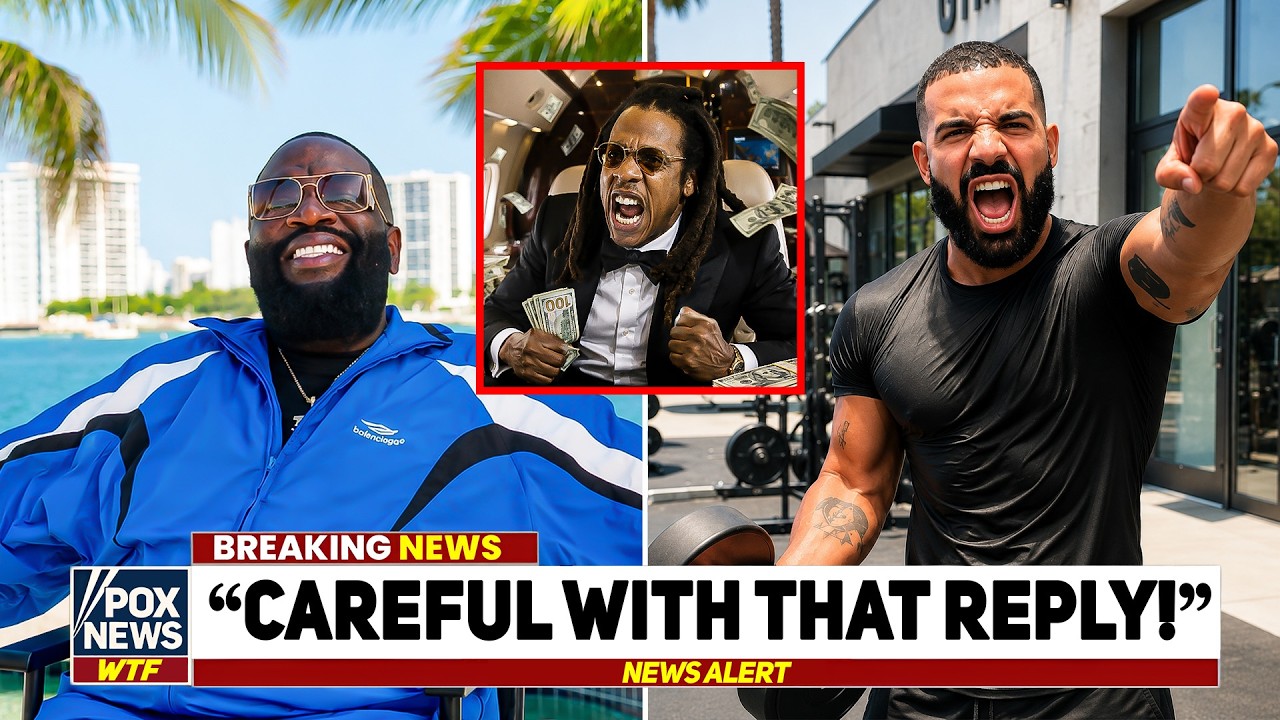 This statement was a direct challenge to the entire rap ecosystem, daring anyone to step into the ring with him.
The genesis of this attack can be traced back to the ongoing tension between Drake and Rick Ross, a feud that has been escalating since Ross made disparaging comments about Drake’s music and character. Drake wasted no time in targeting Ross’s latest album, “Set in Stone,” which reportedly moved only 20,000 units in its first week and 17,000 in its second, the lowest sales figures of Ross’s career. Drake mocked these numbers relentlessly, contrasting them with his own commercial dominance, and suggested that Ross’s decision to diss him had backfired spectacularly.
He pointed out that Ross’s streaming numbers were so low that a single Drake song outperformed the entire album, a claim that was quickly verified by fans who pulled the data. The humiliation was compounded by Drake’s assertion that Ross was “flying economy” while he was in first class, a metaphor for the vast gap in their commercial success. This attack was not just about sales; it was a calculated effort to undermine Ross’s credibility as a heavyweight in the game.
Drake even mocked Ross’s lifestyle, joking about his obsession with food and his girlfriend, and dismissed his lyrical abilities as limited to “eating and girlfriend talk.” The live stream became a platform for Drake to consolidate his position as the alpha in this rivalry, leaving Ross with little room to maneuver.
But Drake’s ire was not limited to Ross; he also took several shots at Roc Nation and its founder, Jay-Z, in what many interpreted as a declaration of war against the entire organization. He mocked Jay-Z’s recent public appearances, suggesting that the legendary rapper had been forced out of retirement to address the situation, and even joked about his age, referencing a colonoscopy and dentures. The most pointed jab came when Drake questioned the loyalty of Roc Nation’s roster, implying that they were all afraid to challenge him directly.
He referenced DJ Khaled’s decision to push back his album release, suggesting it was a strategic move to avoid competing with “Iceman.” This was a direct challenge to Jay-Z’s authority, as Drake positioned himself as the king of the industry who could dictate the release schedules of his rivals. The attack on Roc Nation was particularly significant because it signaled a shift in Drake’s strategy from focusing on individual rappers to targeting the entire power structure that supports them.
He seemed to be suggesting that Jay-Z’s empire was built on a foundation of fear and that he was the one who could expose its weaknesses. This was a high-risk move, as Jay-Z has a long history of responding to challenges with devastating lyrical precision, and many fans are now waiting to see if he will break his silence.
The context of this attack cannot be separated from the aftermath of Drake’s legal battle with Universal Music Group, which was filed in 2024 and alleged that the label had artificially inflated streaming numbers for Kendrick Lamar’s diss track “Not Like Us.” In court documents, Drake’s legal team described the damage to his reputation as “significant,” including “personal humiliation, mental anguish, and emotional distress.” This legal filing has become a double-edged sword for Drake, as critics now point to it as evidence that his tough talk is at odds with his vulnerability in the courtroom.
 During the live stream, Drake seemed to address this contradiction by framing his legal action as a necessary step to protect his legacy, but the internet was quick to remind him of the language used in those documents. The phrase “the pen isn’t dry” took on new meaning, with some fans joking that the only pen Drake was using was the one signing legal documents. This tension between the street persona and the courtroom reality has become a central theme in the ongoing narrative, and Drake’s refusal to back down suggests he is willing to embrace the contradiction as part of his complex public image.
The live stream was a deliberate attempt to reclaim the narrative and project strength, but it also opened him up to further scrutiny from those who see the lawsuit as a sign of weakness.
The reaction from fans and media has been swift and divided, with social media platforms exploding with commentary on every aspect of the live stream. Supporters of Drake have rallied behind him, arguing that his commercial success gives him the right to speak his mind and that his rivals are simply unable to compete with his level of dominance. They point to the numbers: “Iceman” has been certified platinum multiple times over, while “Set in Stone” is struggling to reach gold status.
The contrast is stark, and Drake’s fans are using it as evidence that his critics are out of touch with the realities of the music industry. However, detractors have been equally vocal, accusing Drake of being out of touch with the street culture that once defined hip-hop. They argue that his reliance on streaming numbers and legal threats is a sign that he has lost the respect of the core audience that values authenticity over commercial success.
The debate has become a microcosm of the larger cultural war within hip-hop, pitting the old guard against the new, and the mainstream against the underground. The live stream has also reignited discussions about the role of algorithms in determining success, with some suggesting that Ross’s low numbers are a result of being blackballed by the industry rather than a reflection of his talent.
The implications for Rick Ross are severe, as he now faces the prospect of a career-defining crisis that could reshape his legacy. His decision to engage in a public feud with Drake has already cost him significant commercial momentum, and the live stream has only deepened the wound. Ross has spent the last few weeks defending his album and pushing back against the narrative of failure, but Drake’s attack has made it nearly impossible for him to control the story.
The jokes about his sales have gone 𝓿𝒾𝓇𝒶𝓁, and even his own fans are struggling to defend the numbers. Ross’s response has been muted so far, with him posting cryptic messages on social media that suggest he is plotting a comeback, but the clock is ticking. If he fails to deliver a strong musical response, he risks being remembered as the rapper who was destroyed by Drake’s pen.
 The pressure is immense, and the hip-hop community is watching closely to see if he can rise to the occasion. The situation is reminiscent of other legendary beefs where one rapper’s career was defined by their response to a challenge, and Ross knows that his legacy is on the line.
The Jay-Z angle adds another layer of complexity to the situation, as the legendary rapper has not responded to Drake’s provocations, leaving fans to speculate about his next move. Jay-Z has a long history of ignoring petty insults and focusing on his business empire, but the personal nature of Drake’s attack may force his hand. The reference to Jay-Z needing Beyoncé to comb his hair was a particularly low blow, as it invoked the image of a man who is dependent on his wife for basic tasks.
This was a direct challenge to Jay-Z’s masculinity and authority, and it is unlikely that he will let it slide without some form of response. However, Jay-Z is also a master strategist who understands the value of silence, and he may choose to let Drake’s words hang in the air, knowing that time will reveal the truth. The question is whether the hip-hop community will allow him to remain silent, or if the pressure will build to the point where he has to address the situation.
The speculation is running rampant, with fans analyzing every lyric and interview for clues about Jay-Z’s state of mind.
The live stream also touched on the broader theme of loyalty and betrayal within the industry, as Drake accused several rappers of being “yes men” who are afraid to challenge him directly. He mocked the idea that anyone in his camp would tell him he is wrong, suggesting that his success has insulated him from criticism. This was a revealing moment, as it showed Drake’s awareness of the criticism that has followed him throughout his career.
He seems to understand that his position at the top of the industry has created a bubble where only positive feedback reaches him, but he also seems to embrace it as a sign of his power. The accusation that Ross is surrounded by people who are afraid to tell him the truth was a clever psychological move, as it planted a seed of doubt in the minds of Ross’s supporters. Drake was essentially saying that Ross’s failure is not just his own fault, but the fault of everyone around him who has enabled his delusions.
This was a masterful piece of manipulation, and it shows that Drake is not just a rapper but a skilled propagandist who understands how to shape public perception.
 The commercial implications of this feud are enormous, as both Drake and Ross have significant business interests that could be affected by the outcome. Drake’s partnership with Nike, his whiskey brand, and his various other ventures are all tied to his public image, and a loss in this beef could damage his brand. Similarly, Ross’s car show, his wing chain, and his other businesses are dependent on his credibility as a street figure, and a failure to respond effectively could erode his fan base.
The stakes are high, and both men know that this is not just about music but about their entire livelihoods. The live stream was a calculated risk for Drake, as it put him back in the spotlight and invited scrutiny, but it also gave him the opportunity to control the narrative. He has chosen to frame himself as the victor who is merely confirming what he already knew, and he is daring his rivals to prove him wrong.
The ball is now in Ross’s court, and the hip-hop world is waiting to see if he can deliver a response that will change the conversation.
The role of the media in this feud cannot be overstated, as outlets like Ebro in the Morning have been analyzing every aspect of the situation, adding fuel to the fire. The discussion about algorithms and streaming numbers has become a central theme, with some suggesting that Drake’s influence over the industry is so great that he can manipulate the system to his advantage. This conspiracy theory has gained traction among Ross’s supporters, who argue that his low numbers are not a reflection of his talent but of a rigged system.
However, Drake’s fans dismiss this as sour grapes, pointing out that Ross’s album simply did not resonate with listeners. The media’s role in amplifying these narratives has made it difficult for either side to control the story, as every new development is dissected and debated in real time. The live stream has become a cultural event, with millions of views and countless reactions, and it has cemented Drake’s position as the most talked-about figure in hip-hop.
The future of this feud is uncertain, but one thing is clear: Drake has no intention of backing down. He has positioned himself as the dominant force in the industry, and he is using every tool at his disposal to maintain that position. The live stream was a declaration of war, and the response from Ross and Jay-Z will determine the next chapter in this saga.
If Ross can deliver a strong musical response, he may be able to salvage his reputation and turn the tide. If he fails, he risks being remembered as a footnote in Drake’s rise to power. For Jay-Z, the choice is between engaging in a battle that could define his legacy or remaining above the fray and letting his business speak for itself.
The hip-hop community is watching with bated breath, and the next few weeks will be critical in shaping the future of the genre. The tension is palpable, and the only certainty is that the 𝒹𝓇𝒶𝓂𝒶 is far from over.


