The trial of Lindsay Clancy has taken an explosive turn as newly scrutinized testimony from her ex-husband, Patrick Clancy, has ignited a firestorm of questions about the precise sequence of events on the day their three children were killed. While Lindsay Clancy, 34, admits to strangling 5-year-old Cora, 3-year-old Dawson, and 8-month-old Callan in the basement of their Duxbury, Massachusetts home on January 24, 2023, her defense argues she was in the grips of postpartum psychosis and not criminally responsible. However, the narrative has shifted dramatically online and now inside the courtroom as Patrick Clancy’s own timeline, established under oath, appears to contain a series of puzzling gaps and contradictions that have left even seasoned legal observers questioning the official account.
The controversy centers on a period of roughly 14 to 15 minutes that prosecutors questioned extensively during Patrick’s testimony. According to his own statements, Patrick left the family home at approximately 5:15 p. m.
 after his wife asked him to pick up takeout dinner and a stool softener for their daughter. The CVS pharmacy was merely a three-minute drive from the house, which would have placed him in the parking lot around 5:18 or 5:20 p. m.
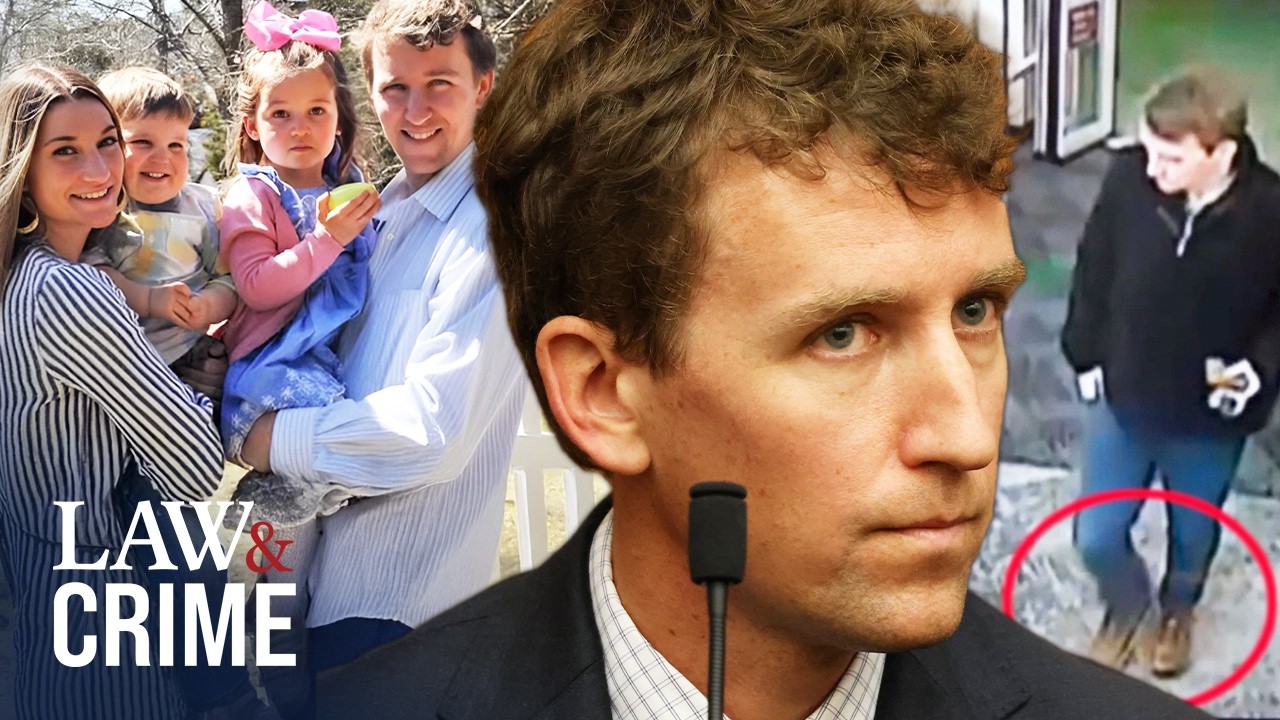
Yet, security footage shows Patrick Clancy did not actually enter the store until 5:32 p. m. This discrepancy has become the focal point of a growing online investigation that has expanded into a full-scale dissection of his every movement.
During direct examination, prosecutors pressed Patrick on this exact point. When asked why there was a 12 to 14-minute delay between his expected arrival and his actual entrance, Patrick responded with uncertainty, saying, “I don’t know.” He could not explain what he was doing during that window.
The confusion deepened when the court was presented with a digital record of an email Patrick sent to his co-workers at 5:24 p. m. , a full eight minutes before he walked into the CVS.
The email header showed it was sent from his “Surface Pro” laptop, a device that, according to the Commonwealth’s evidence, was most likely at home.
Patrick initially agreed the email came from his Surface Pro before quickly backtracking, testifying that “it could have been sent from my iPhone.” This six-minute shift in his recollection did little to quell the growing suspicion. Prosecutors re-established that he was, in fact, away from the house at that time, pointing to his use of the phone inside the store.
Still, the question remains: if he was in his car, why did it take him over ten minutes to go inside, and why did his email metadata suggest a different device origin? The Commonwealth maintains he was simply sitting in his vehicle, but no evidence of a phone call, text, or other activity has been provided to fill that void.
The implications are severe because the timeline is critical to the prosecution’s case that Lindsay Clancy acted with premeditation and a sound mind. They argue that the murders occurred in a very tight window while Patrick was gone. The defense, led by attorney Kevin Reddington, has used the timeline to suggest that Lindsay acted in a psychotic episode, but the prosecution’s theory relies on a precise sequence of events.
If Patrick was not where he said he was, the entire framework of the case is thrown into question.
The online community, which has been watching this trial with intense scrutiny, has latched onto another alleged inconsistency: Patrick Clancy’s clothing. Security footage from the CVS at 5:32 p. m.
 appears to show him wearing brown boots and a half-zip jacket. Yet, just 22 minutes later, when he arrived at the 3V restaurant in Plymouth to pick up the takeout order, video from 5:54 p. m.
appears to show him wearing different footwear—tennis shoes—and a full-zip jacket. The change, if real, is suspicious to many who argue it implies a stop or an action he has not disclosed.
When asked about this during his testimony, Patrick did not provide a clear explanation. He simply testified that when he returned home, he “started taking my boots off,” suggesting he had been wearing boots at some point. But the video evidence presents a direct visual discrepancy that has not been reconciled.
Some experts suggest the lighting in the dim restaurant could distort the appearance of the shoes, while others point out that Massachusetts winters often require drivers to keep extra shoes in their cars. However, the lack of admission or explanation from Patrick himself has fueled the fire.
The scrutiny does not end there. The timeline of the murders themselves is almost impossibly tight. Lindsay Clancy is accused of strangling each of her three children with exercise bands, a process that typically takes several minutes per victim.
She then reportedly took pills, slit her wrists and neck, and jumped from a second-story window. The prosecution presented evidence that the calls and texts between Patrick and Lindsay during this period were brief and seemingly normal. At 5:33 p.
m. , Patrick called Lindsay from the CVS to ask about a generic brand of stool softener. She called back a minute later.
Her voice was described as quiet, but coherent.
The defense argues that the sheer brutality and the tight timeline support the idea of a sudden, violent psychotic break rather than a calculated plan. But the online sleuths argue the opposite: that the timeline is too tight for one person to have committed the murders alone. They point to the fact that Lindsay was found with severe injuries, including a neck wound that compromised her airway, making it difficult to speak.
 Yet, Patrick testified she told him, “I tried to 𝓀𝒾𝓁𝓁 myself,” and that the kids were in the basement. Critics question how she could have uttered those words if her throat was cut.
Patrick’s 911 call, which was played in court but not publicly released due to court order, has also become a subject of intense debate. One witness described hearing Patrick’s “primal scream” as he discovered the bodies. He was heard saying, “She killed the babies,” to the dispatcher.
The raw emotion was palpable, but for some, the exact nature of his actions during those crucial minutes remains unclear. He removed the exercise bands from his children’s necks, but he could not revive them. He then waited for first responders, who arrived within four to five minutes.
Patrick Clancy has not been charged with any crime. He has been cooperative with investigators since the beginning, providing DNA samples and detailed interviews. The Commonwealth has repeatedly stated he is not a suspect.
Yet, the court of public opinion has placed him on a far more uncertain pedestal. The discourse has evolved into a full-blown conspiracy theory for some, who argue that Patrick might have been involved or that Lindsay was manipulated into confessing. This theory is fueled by the belief that the “missing 15 minutes” could have been used to commit the murders himself or to stage the scene.
The defense team of Lindsay Clancy has been strategic in its questioning, probing Patrick’s memory and highlighting the trauma he has endured. They have also introduced evidence suggesting that Lindsay’s mental state had deteriorated over the weeks leading up to the tragedy, with multiple doctors appointments and prescriptions for psychiatric medications. The prosecution, however, continues to characterize Lindsay as a woman who was in control of her actions, pointing to her ability to order takeout, text about dinner plans, and purchase stool softener.
The legal proceedings have now become a battleground over a single question: what really happened in those 15 minutes? The jury, who has been instructed not to view any media coverage or conduct independent research, has only the testimony and evidence presented in court. They did not see the side-by-side comparisons of the alleged shoe change or the metadata analysis that has gone 𝓿𝒾𝓇𝒶𝓁 online.
They only have Patrick Clancy’s memory of a day that shattered his life.
Despite the overwhelming focus on Patrick, the legal case remains about Lindsay Clancy’s state of mind. She faces three counts of first-degree murder. Her attorneys have admitted she killed the children, but they argue she was legally insane at the time, unable to distinguish right from wrong.
 The prosecution must prove she acted with deliberate premeditation and malice. The timeline is central to that argument. If Patrick’s movements are unclear, the state’s timeline of the murders becomes less certain.
The online discourse has not gone unnoticed by the court. Judge Beverly Cannone has routinely cautioned the jury to ignore outside information. However, the sheer volume of public speculation has created a parallel narrative that is impossible to ignore.
Social media platforms are flooded with threads analyzing every second of the security footage, every word of the text messages, and every detail of Patrick’s testimony. The hashtag #PatrickClancy has trended repeatedly.
Law enforcement has also come under fire for what some see as a failure to fully investigate the husband’s alibi. The Massachusetts State Police have not commented on the specific allegations, but their reports show that Patrick was interviewed extensively on the night of the incident and his movements were verified through GPS data and surveillance. The lack of a public explanation for the 12-minute gap has only fueled the mistrust.
The next phase of the trial will feature expert witnesses for the defense, including psychiatrists who will testify about Lindsay’s mental state. The prosecution will present its own experts who will argue that her actions were consistent with a conscious, deliberate plan. The battle over the timeline will likely intensify once the defense has its own chance to cross-examine the forensic evidence.
For now, Patrick Clancy remains a central figure in a story that has captivated the nation. A father who lost everything, yet now finds himself the subject of intense suspicion. Whether those suspicions have any merit will likely be debated long after the trial concludes.
But the questions linger: what was he doing for those 15 minutes? Why did his email come from a device that might have been at home? And did his shoes really change?
These are the riddles at the heart of a case that has no easy answers.
The trial is expected to continue for several more weeks. The jury will ultimately decide if Lindsay Clancy was insane or a murderer. But the mystery of Patrick Clancy’s timeline may never be fully resolved, leaving a dark cloud over a story already defined by unimaginable tragedy.


