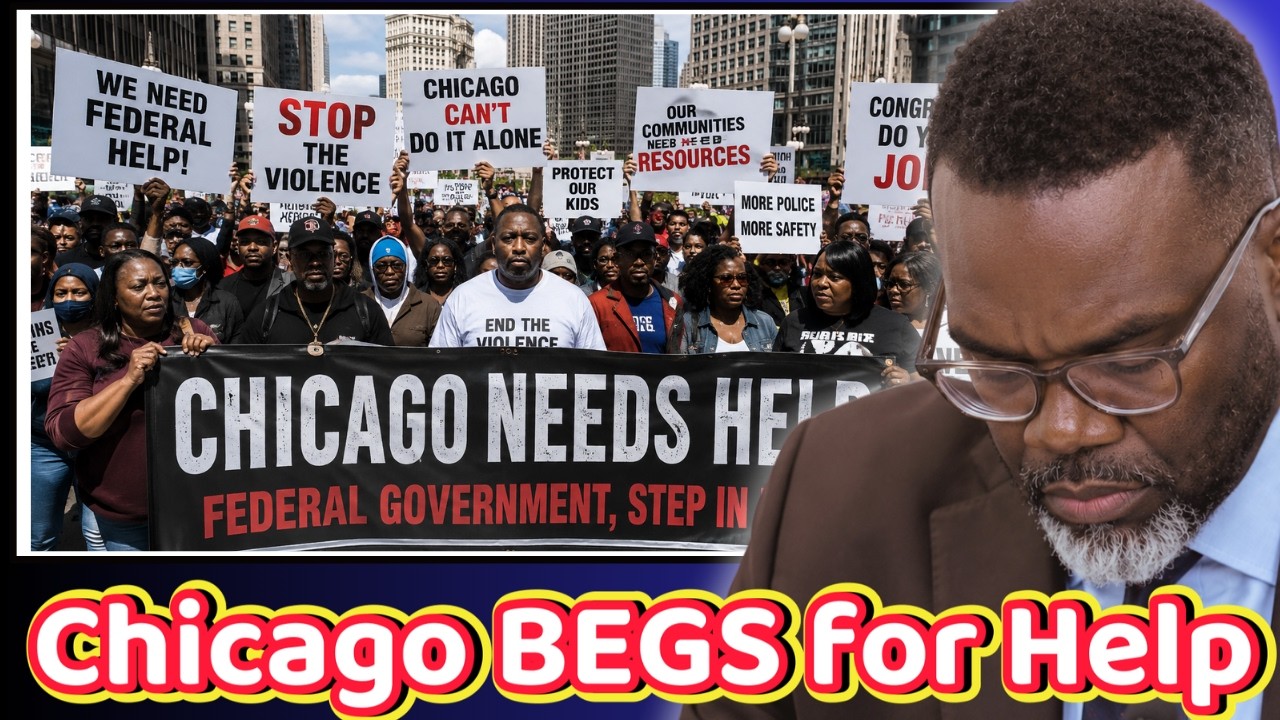
Chicago residents are begging the federal government to step in, and the message is blunt: they’re living in fear and they can’t take it anymore. The plea came from inside a restaurant in the Bridgeport neighborhood, where community members gathered after yet another wave of deadly shootings. Officials reported at least seven separate shootings with no known connections across the city in just one stretch of hours. A man was gunned down near 45th and Honore around midnight.
Two hours later, a 32-year-old was fatally shot in West Garfield Park. Thirty minutes after that, a 29-year-old standing by his car near 28th and Kedzie was killed in a drive-by. By morning, gunfire erupted again before 8:30, leaving three more people shot in the Austin neighborhood. “Anybody could be the next victim here,” one resident said.
“So, we’re calling on federal funding from Congress. We need more violence prevention initiatives. We need more police. We need more cameras.
We need to work together. ”
Another speaker didn’t bother hiding their frustration. “When is this going to stop? ” they asked, as others nodded in agreement.
“The carnage continues throughout Chicago, and we’re tired of it already. ”
There was also a hint of surrender in some of the voices. “I’m not counting on the politicians to fix this,” one community member admitted. “I’m not waiting for the police to do anything.
We, the people, have to come together and figure out a different way of handling things when we get upset with one another. ”
What made the scene striking was what wasn’t there. No massive crowds. No neighborhood patrols.
No wall-to-wall media coverage. Just a handful of residents in a restaurant, hoping someone above the city’s leadership would hear them. And that raised an uncomfortable question: where were all the activists now? The difference in response was hard to ignore.
When federal immigration agents swept through Chicago earlier in the year, the city erupted. Thousands of people flooded the streets daily. They formed neighborhood patrols. They used technology to track the agents’ movements and warned each other in real time.
They rammed enforcement vehicles with their own cars. The rallying cry was constant: “Stop tearing our communities apart. Stop terrorizing our families. ”
Back then, there was no shortage of people ready to fight.
They had the organizers, the signal chats, the lookouts, the willingness to physically block federal action. They made it nearly impossible for the agency to do its congressionally mandated job. And eventually, the tactics changed because the entire community turned against them. That pushback worked, at least in stopping those operations.
But the same energy hasn’t shown up for the violence that never stopped. No one is organizing patrols against the gang activity that claims lives nightly. No one is racing out to block the carjackings, the robberies, the drug deals, or the open-air extortion. No one is forming a human wall between the gunmen and their targets.
One resident put it plainly: “So, the carnage continues throughout Chicago, and we’re tired of it already. ” But the tiredness hasn’t translated into the same kind of urgent, angry mobilization that followed the federal raids. That silence is deafening to many residents, especially those in the neighborhoods that get hit hardest, like Little Village, where a 29-year-old man was killed in a drive-by on South Kedzie. Or Back of the Yards, where police found another man shot to death on South Honore.
Or West Garfield Park, where a 32-year-old died at the scene after being shot in the head. There was also a stabbing in Albany Park, just before 2:00 a. m. , on North Avers Avenue.
A woman was found with a knife wound to her neck. No arrests were reported. The people who gathered at Bold Mongol restaurant said they’re not naive. They don’t have a perfect answer.
They just know they can’t live this way anymore, and they don’t trust the people in charge to fix it. So they’re hoping the federal government will step in where local leadership hasn’t. They’re asking for funding, for resources, for a coordinated response. They’re asking for help.
But here’s the tension. The official statistics tell a different story, and city officials are counting on those numbers. According to crime data analyzed through July 31st, homicides over the last 12 months are trending up 1. 4% compared to last year.
However, the murder rate is still down compared to the annual average over the last three years. On paper, that sounds like progress. Residents aren’t buying it. “Do you trust the stats?
” one resident asked. They see what they live every day, and no spreadsheet can convince them that the streets are getting safer. Across the country, cities like Baltimore and Chicago report declining violent crime, but the numbers don’t match the daily reality. In Washington D.
C. , there were even reports of crime statistics being faked to make things look better than they were. No one is saying that’s happening in Chicago, but the mistrust is there. The question now is whether the federal government will actually respond to the plea.
That remains unclear. What is clear is that Chicago is a city divided between its official narrative and its lived experience. The leaders point to the numbers and say things are improving. The residents point to the bodies and say they can’t sleep at night.
Mayor Johnson, whose approval rating has hovered in the single digits, hasn’t given residents much reason for confidence. There are whispers that he’s preparing to announce his re-election bid soon, and he has the backing of the powerful Chicago Teachers Union. But his own constituents are openly asking for help from anyone who doesn’t answer to him. That says something about the state of trust in the city’s leadership.
When a mayor can’t get his own residents to believe he can keep them safe, and they’re turning to Washington D. C. instead, it’s a sign of deep dysfunction. The activists who filled the streets during the ICE raids still exist.
They still have the organizational skills, the technology, and the passion. They proved they can mobilize quickly when they feel threatened. But the threat they’re facing now is different. It’s not coming from federal agencies with uniforms and warrants.
It’s coming from within their own neighborhoods, wearing no uniform at all. And that seems to have left everyone stuck. The people who fought so hard to protect their communities from outside enforcement haven’t found the same urgency to protect them from inside violence. In the meantime, the shootings continue.
The families keep grieving. The residents keep hiding inside their homes. So they wait for an answer from the federal government. They wait for a response from Congress.
They wait for someone to show up with a plan, with funding, with a solution that makes sense on the ground, not just on paper. And while they wait, they wonder about the activists who showed up for other causes. They wonder why some lives seem to matter more than others. They wonder why it took so much energy to stop federal agents, but barely a fraction of that energy goes toward stopping the gunmen in their own streets.
This isn’t a political argument. It’s a survival question. Chicago residents are asking for help because they’ve run out of options. They’re asking outsiders to care about their neighborhoods the way they cared about other neighborhoods when the cameras were rolling.
The gathering at Bold Mongol restaurant wasn’t the start of a movement. It was a cry from people who feel abandoned by everyone who promised to protect them, including the very people who once took to the streets claiming to stand for their community. They ended the night with no answers, just a request. “Anybody could be the next victim here,” one of them said.
“So, we’re calling on federal funding from Congress. We need more violence prevention initiatives. We need more police. We need more cameras.
We need to work together. ”
Whether anyone will listen remains to be seen. But the residents made it clear that they refuse to stay silent. They refuse to accept that this is just how it has to be.
They’re done waiting for things to change on their own. Yet the streets remain dangerous, and the silence from the people who once led the charge for community protection is growing louder than the gunfire. Now the question is: will the federal government answer the call that local leaders haven’t?
Or will Chicago’s plea become just another story told at a restaurant that never changed anything?