The first time I saw the list, I was fourteen years old, sitting on the floor of my grandfather’s study. The room smelled of old paper and dust, and I had been forbidden from touching anything. But the list was lying right there on the low shelf, its cover plain, its title stamped in faded black letters. I pulled it out anyway.
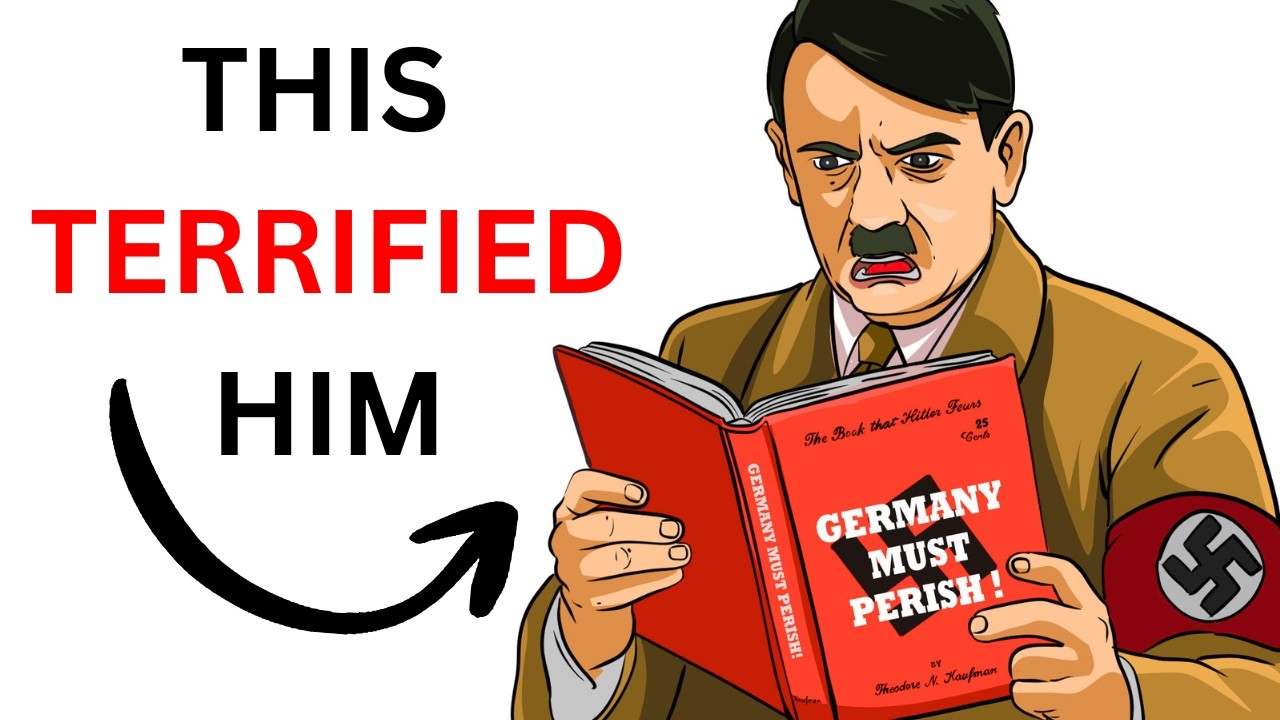
“Germany Must Perish,” I read aloud, and my grandfather’s hand shot out, snatching it from my grasp. His face, usually soft with the patience of a man who had survived more than he ever spoke about, had gone hard, white at the edges of his mouth. . “Do not read that,” he said quietly.
“Not in this house. Not ever. ”
I didn’t understand then. I thought it was a history book, something about the war, like the others he kept hidden in the back of his closet.
But why would he be so afraid of a book? He was a German Jew who had escaped in 1938, leaving behind his parents, his sisters, everything. He had never once said the word genocide out loud, but his silence was louder than any scream. He kept his grief in a locked drawer, and his rage in a language he no longer spoke.
. But I was young, curious, and foolish. I waited until he fell asleep that afternoon, slipped back into the study, and opened the book to the first chapter. The author, Theodore N.
Kaufman, was an American Jew from New York. He had written this book in 1941, when the world was burning, when the newsreels showed nothing but ruined cities and piles of bodies. He asked a question that many were asking: What do we do with Germany after we win? His answer was not prison camps.
It was not reparations. It was not even execution of the Nazi leaders. He proposed something more absolute, more clinical, more terrifying than anything Hitler had ever done to his enemies. .
“Sterilization,” I read, my voice shaking even though I was alone. The words blurred for a moment, then sharpened. . He wanted to sterilize forty-eight million Germans.
Not the old, not the infants—although the infants would not be safe for long. Just the men and women of childbearing age, pausing reproduction forever, wiping out the entire German people in a single, bloodless, bureaucratic stroke. He called it the only way to ensure world peace. He compared the Germans to wild animals, poisonous reptiles, creatures that could never change their nature, that would always return to violence unless their bloodline was erased from the earth.
He talked about dismantling the country, carving it up between neighbors, forcing the survivors to learn new languages, closing their schools, burning their identity, until Germany was nothing mais than a name on an old map, if even that. . My hands trembled. I had heard stories of what the Nazis did, of course—the camps, the gas, the medical experiments.
My grandfather’s entire family had been swallowed by that system. But this book was different. This was not the plan of the monsters. This was the plan of the righteous, the avengers, the people who thought of themselves as the saviors of civilization.
This was the plan of men who looked like my grandfather’s neighbors back in Berlin, who went to synagogue on Saturdays and spoke of justice over dinner, and who believed, truly believed, that the only way to stop murder was to make sure a nation of eighty million people simply stopped existing, one generation at a time, without war, without gas chambers, without even a single bullet. Just a quiet, efficient ending, performed by twenty thousand surgeons working in shifts, like factory workers on an assembly line, processing human beings out of existence. . I closed the book.
My hands did not stop shaking. I thought of my grandfather, sleeping in the next room, his breath slow and even, his dreams full of people he would never see again. I thought of him saying, “Not in this house,” and I finally understood why. He had spent his whole life running from the people who wanted to erase his people.
He had built a new life on a new continent, speaking a new language, raising children who would never know the names of his parents, his sisters, his childhood friends. He had survived the Holocaust by leaving everything behind, and he had never once raised his voice in anger about it. . And now he was old, fragile, dying slowly of the same grief that had always been inside him.
And I was holding a book, written by an American Jew, that argued that his pain, his loss, his family’s murder, was not enough. That argued that the only way to honor the victims was to make sure the Germans themselves disappeared, not through violence, not through vengeance, but through cold, medical, administrative precision. That argued that they were all the same, all guilty, all irredeemable, all deserving of being erased from history as systematically as the Nazis had erased mine. I couldn’t breathe.
I slid down against the bookcase, the book open across my knees, and I stared at the ceiling, counting the cracks in the plaster, trying to remind myself where I was. I was in America. I was safe. I was not a character in this horror story.
But the words kept pulling me back in. I read about Kaufman’s plan to turn Germany into a pastoral land of small farms, stripped of industry, stripped of ambition, stripped of memory. I read about how the Allies would guard the factories and forced German laborers to rebuild the cities their soldiers had destroyed, while foreign workers took their jobs, while their children attended schools where their own language was forbidden. I read about how Austria would be erased too, absorbed into neighboring states, until the very map of Europe no longer contained the names that had terrorized the world for centuries.
. And then I read the reviews. The New York Times called it sensational. Time magazine called it a radical idea.
They did not call it genocide. They did not call it murder. They did not call it what it was. They called it a plan, a proposal, a controversial suggestion for how to secure peace.
And somewhere, far away, in a bunker in Berlin, a man named Joseph Goebbels was reading the same words, and he was smiling. That was the part that made me sickest. I knew about Goebbels. I knew how the Nazis used everything, every insult, every threat, every careless word from their enemies, as proof that they were right, that the world really did want to destroy Germany, that the Jews really were plotting against them.
And here was an American Jew, handing them the perfect propaganda gift, writing a book that literally said, in print, for anyone to read, that all Germans should be sterilized, that Germany should cease to exist, that its people should be erased from the face of the earth. I could almost hear Goebbels’ radio voice, smooth like poison, tellingthe German people: “Look at what they plan for you. Look at what the Jews have written. They do not want to defeat us.
They want to exterminate us. They want to take our children, our future, our very blood. And so we must fight, not for victory, but for survival itself. ” The book had been published in 1941.
The Nazis had seized on it immediately. They had used it to justify everything, the Final Solution, the camps, the murders, telling their people that they were only defending themselves against a world that wanted to wipe them out. And perhaps some of them had even believed it, because why wouldn’t they, when an actual Jewish author had written an actual book saying actual words proposing actual genocide against them? I thought of my grandfather again.
He had been a young man when Hitler rose to power. He had watched his neighbors, his colleagues, his old schoolmates turn on him, one by one, until he was alone. He had escaped with nothing, leaving behind a family that would be dead within five years, murdered in camps whose names he could never bring himself to say out loud. And now, years later, an American Jew had written a book that handed the Nazis the final justification for all of it.
I didn’t want to believe it. I read the passages again, looking for some nuance, some context, some sign that Kaufman was speaking metaphorically, that he didn’t really mean it. But the words were clear. He meant it.
He meant every word. He believed that Germans were biologically incapable of change, that they were a species of predators, that the only way to have peace was to make sure no more of them were ever born. I sat there for a long time, the book open in my lap, the daylight fading through the dusty windows. My grandfather’s breathing was still slow and even in the next room.
I thought about all the books that had been burned in 1933,Berlin, thousands of them, heaped in giant pyres while students sang patriotic songs. They had burned Magnus Hirschfeld’s work, the Jewish sexologist who had fought for gay rights and trans rights, who had coined the word transvestite, whose institute had been looted and whose library had been thrown into the flames, his life’s work reduced to ash because he had dared to research the human heart and its many forms of love. They had burned Ilya Ehrenburg’s words, the Soviet writer who had told Red Army soldiers to show no mercy, top focus only on killing every German they saw, whose pamphlets had been passed from hand to hand in the trenches of Stalingrad, fueling a hatred that had burned so hot it had consumed civilians, women, children, everyone caught in its path. They had burned the Communist Manifesto, Karl Marx’s call for workers of the world to unite, seeing in it a threat to their nationalist dream, a specter of class war that could tear apart the Volk.
They had burned Hemingway’s A Farewell to Arms, calling it cowardly, un-German, because it showed war as it really was, not as glorious sacrifice but as chaos, suffering, senseless death, and they had banned it in Italy too, because even Mussolini knew that pacifism was dangerous to a nation preparing for conquest. They had burned Helen Keller’s How I Became a Socialist, her book arguing that capitalism crippled the poor, that cooperation, not competition, was the way forward, and she had responded with a letter, telling them, “You can burn my books, but you cannot burn my ideas,” while they called her work intellectual garbage and threw it onto the pyre alongside the rest. They had burned Jack London’s The Iron Heel, his novel about a brutal oligarchy crushing workers, and they had missed the irony that they were building exactly the kind of regime he had warned about, a dictatorship of the super-rich, the secret police, the false flags, until the novel seemed moins like fiction than prophecy. They had burned Robert Vansittart’s Black Record, his book arguing that all Germans were barbarians, that their history was a long chain of aggression, and they used it as proof, “You see?
They think of us as animals. They want to destroy us. ” They had burned Henry Morgenthau’s plan, his proposal to dismantle German industry, to turn the country into farmland, to execute Nazi leaders without trial, to force the population to rebuild what they had destroyed, and the Nazis had used that too, calling it a Jewish plot to enslave Germany, rallying their people to fight to the last breath. They had burned Paul Winkler’s The Thousand Year Conspiracy, his claim that Nazism was not Hitler’s invention but an ancient, hidden force, a secret Germany that had always sought world domination, a system that would survive even if the Führer fell.
And they had burned all these books, these warnings, these accusations, these proposals, some just, some monstrous, all flammable, all reduced to ash in the flames of their own paranoia. And yet, the book in my hands, this book that I had pulled from my grandfather’s shelf, had not been burned. It had not been suppressed. It had been published in New York, reviewed by respectable newspapers, discussed by respectable intellectuals, treated as a serious contribution to the debate about what to do with Germany after the war.
And that, somehow, was the most horrifying part of all. Because it meant that the desire to erase a people was not a German invention. It was not a Nazi disease. It was a human possibility, dormant in all of us, waiting for the right combination of fear, hatred,and self-righteousness to bring it to life.
It meant that my grandfather’s family had been murdered not by monsters, but by men who could read, men who could write, men who could convince themselves that their cruelty was justice, men who were not so different from the American Jew who had written this book, or from the Soviet propagandist who had urged soldiers to kill every civilian in their path, or from anyone else who had ever looked at a group of human beings and decided that they were not really human, that they were animals, vermin, threats to be eliminated for the good of the world
. I finally closed the book and put it back on the shelf, exactly where I had found it. I stood up, my legs stiff, and I walked to the door of my grandfather’s study. He was awake now, sitting up in bed, looking at me with those eyes that had seen too much ever to be surprised again.
He didn’t ask what I had been doing. He didn’t need to. He just said, softly, in German, the language he never spoke anymore: “Du hast es gelesen, nicht wahr? ” You have read it, haven’t you?
I nodded. I couldn’t speak. He sighed, a long, tired breath, like wind through ruins. Then he said, in English, each word slow and deliberate: .
“You know what they did with that book, don’t you? The Nazis. They used it. They used every word of it.
They told their people: ‘Look what the Jews want to do to you. Look what they have planned. They want to sterilize you, to erase you, to make sure no German child is ever born again. ‘ And their people believed them, because they were afraid, and fear makes people believe anything.
And so they fought harder, and they killed more, and they dragged the whole world into hell, all because a man in New York, who thought he was saving civilization, wrote a book that handed the devil his sharpest knife. ”
I looked at him, at his pale face, his thin hands, his eyes full of ghosts, and I asked the question that had been burning in my chest since I opened that book:”Did he know? Kaufman. Did he know what his words would do?
”
My grandfather was silent for a long moment. Then he said:”I don’t know if he knew. I don’t know if he cared. I only know what happened.
Words are not neutral. They are not just sounds in the air. They are seeds. They grow into forests or into deserts, depending on who waters them.
And this man, this American, this Jew, he planted a garden of thorns, and the Nazis harvested it, and they used it to justify the murder of millions of people, including my mother, my father, my sisters, everyone I ever loved. And they did it with his words in their hands, telling their people, ‘We are not the aggressors. We are defending ourselves. Look, look what they plan for us.
‘”
He closed his eyes. His voice dropped to a whisper. “I have spent my whole life trying to forget that book. I thought if I hid it away, if I never spoke of it, it would lose its power.
But it doesn’t. It never does. Because the words are still out there, in the world, being read by other people, who will use them for their own purposes, their own hatreds, their own wars. You cannot burn a book, my child.
You can only bury it, and it will always grow back. ”
He reached out, and his hand, trembling, old, covered with the papery skin of a man who had been through too much, closed around mine. His grip was surprisingly strong. “Listen to me,” he said, his eyes suddenly sharp, burning.
“I survived because I got out. My family did not survive because no one got out. And I have spent every day since wondering if there was something we could have done, some warning we could have given, some way to stop it before it started. And now I know.
There was no stopping it. There was no warning loud enough, no argument strong enough, no proof clear enough, because people do not want to hear that they are capable of evil. They want to believe that evil is out there, in others, in the enemy, in the people who are not like them. And so they will always, always, write books like this one, calling for the destruction of those they fear, convinced they are righteous, convinced they are saving the world, never seeing the flames they are feeding until it is too late.
”
He let go of my hand. He lay back against the pillows, exhausted, his eyes closing. He whispered, almost to himself:”I thought I had escaped. I came to America, I built a life, I had a family.
But I never escaped. I have been carrying that fire inside me ever since. And now you know too. You know what is in that book.
You know what people are capable of. And you will have to live with that knowledge fora long, long time, because you cannot unread a book any more than you can unbring the dead. ” He paused, then, his voice barely audible:”But you can choose what to do with what you have read. You can let it turn you bitter, like me.
Or you can let it make you wise. ” I didn’t know what to say. I didn’t know what to think. I only knew that the world felt different, heavier, more dangerous than it had an hour ago, whileI sat there in the fading light, holding a book that had been written in hate, used in hate, and buried in silence, waiting for someone like me to open it again and bring it back into the light.
My grandfather fell asleep, his breathing slow and even, his face peaceful for the first time all day. I sat beside his bed, holding his hand, watching the darkness fill the room, thinking about all the books that had been burned, all the books that had been banned, all the books that had been written with good intentions and used for evil purposes, and all the books still out there, waiting,. I thought about Kaufman, sitting at his desk in New York, writing his plan to sterilize a nation, believing he was a hero. I thought about Goebbels, reading it, sharpening it into a weapon, using it to send millions to their deaths.
I thought about my grandfather, hiding it on his shelf, unable to destroy it, unable to forget it, carrying its weight for sixty years. And I thought about myself, a teenager, born decades after the war, half a world away, pulled into this story by a dusty book on a forbidden shelf, now unable to push it back out of my mind. That night, I dreamed of fire. I dreamed of students in brown shirts, heaping books onto bonfires, while they sang songs of patriotism and hate.
I dreamed of a man in Berlin, listening to a radio, hearing his own name read aloud, a Jewish name, a threat, a target. I dreamed of my grandfather, young, running through a city full of burning synagogues, carrying nothing, saving nothing, leaving everyone behind. I dreamed of a woman in New York, reading a book review, nodding, agreeing that yes, this was the way, this was the plan, this was what the world needed, never realizing who was in the spell she was weaving along with the story. I dreamed of a world where every book carried seeds of both healing and destruction, hope and horror, life and death, and I woke with my grandfather’s voice in my ears, saying,”Words are seeds.
You cannot unburn a book. You cannot unread a book. But you can choose what to do with what you have read. ”
And I knew, then, that I would never be the same.
Not because of what I had read, but because of what I had learned: that evil is not other people. Evil is a possibility inside every one of us, waiting for the right book, the right fear, the right moment to bloom. And the only defense is not censorship, not burning, not silence. It is the harder, slower, braver work of learning to see the humanity in those we fear, those we hate, those we want to erase from the earth.
I looked out the window at the gray dawn, at the sleeping street, at the ordinary world going about its business, unaware of the fires still smoldering under its foundations. And I made a decision. I would not let that book turn me bitter. I would not let it make me afraid.
I would carry it with me, not as a weapon, not as a burden, but as a warning, a reminder, a map of the road we must never walk again. I would tell the story, even thoughthe story was dark, even though it implicated my own people, my own history, my own heart. Because that is the only way, I think, to make sure the fire does not catch again. Not by burning books, but by reading them.
Not by silencing witnesses, but by listening to them. Not by erasing the enemy, but by refusing to become them. My grandfather died three years later, quietly, in his sleep, holding a photograph of his parents, the only thing he had saved from Germany. I inherited his study, his books, his locked drawers, his silence.
I never kept “Germany Must Perish” on the shelf. I kept it in a box, under my bed, where I could find it, where I could open it when I needed to remember. And every time I did, I thought of my grandfather, and I thought of the student in Berlin, throwing books into the fire, believing he was purifying the world, and I thought of Kaufman, writing words that would fuel a genocide he never intended, and I thought of all of us, all of us who read, all of us who write, all of us who carry ideas in our heads like seeds in our hands, unsure what will grow until it is too late, or just in time, to plant something better. The last time I opened the box, I found a piece of paper, yellowed, folded, tucked between the pages of the book.
It was in my grandfather’s handwriting, in German, dated a week before he died. It said:”I am sorry I kept this book. I am sorry I hid it. I should have burned it, or I should have spoken of it, and I did neither.
I thought silence was protection. It was not. Silence is what allows the fire to grow unseen. We must speak, even when it is hard.
We must read, even when it hurts. And we must never, ever forget that the people we call monsters are not born. They are made, by books like this one, by words like these, by the choices of ordinary people who thought they were righteous and instead became the thing they feared. Forgive me.
I did not know what else to do. I loved you. I loved you all. And I wanted to save you, from the fire I have been carrying ever since I was your age, ever since I first learned that the world is full of people who want to burn others to save themselves, and I did not know how, how, to teach you to survive without becoming one of them.
” I closed the box. I did not cry. I had done enough of that. I just sat there, holding the letter, holding the book, holding the weight of his silence and his love and his fear, thinking about all the words we leave to our children, not knowing what they will grow into, hoping, praying,that we have planted enough seeds of light to hold back the dark một chút longer, enough for them to find their own way, enough for them to read what we could not say, enough for them to choose wiser than we did, enough for them to break the cycle that has been burning since the beginning of time, and maybe, just maybe, to plant something new.
I kept the book. I kept the letter. I told his story, and I told the story of all the burned books, and I told the story of the men who wrote in hate and the men who read in fear and the women who chose silence because they did not know what else to do. And I hoped, every day, that somewhere, someone was reading my words the way I had read my grandfather’s, and choosing wiser than I had, and breaking the chain, and planting something the world had never seen before.
That is all we can do. That is enough. That has to be enough. In the end, what I remember most is not the horror, not the hate, not the burning.
It is my grandfather’s hand, trembling, closing around mine, saying, “You can choose what to do with what you have read. ” And so I chose. I chose to remember. I chose to speak.
I chose to believe that even though every book can be a weapon, every book can also be a gift, a warning, a miracle, a seed of light in a world that sometimes seems made entirely of shadow. We carry the fire with us, all of us, every generation, every reader, every writer. It is what we do with it that makes us human.
It is what we do with it that decides whether the dawn will come, or whether the fire will consume us all.