The reemergence of a federal wiretap recording has ignited a firestorm within the hip-hop community, as Brooklyn street OG Manduu Warrior directly confronts rap mogul Jim Jones with decades-old questions that refuse to be silenced. The resurfaced audio, connected to the sweeping 6ix9ine federal case, has placed the Diplomats co-founder back in the crosshairs of a street debate about accountability, power, and the discrepancy between who faces justice and who walks away. In a sprawling, volatile commentary, Manduu Warrior delivered a scorching indictment, alleging a double standard in how the legal system treated figures connected to the same criminal conspiracy, a narrative that threatens to overshadow the legendary status of the Harlem rap icon.
The renewed controversy revolves around a recorded phone call that authorities captured during the investigation that ultimately ensnared Tekashi 6ix9ine and numerous associates. According to the resurfaced audio, a voice matching Jim Jones’ is heard allegedly goading another party to continue firing at individuals until security personnel were eliminated or abandoned their posts, a statement seemingly tied to a shooting incident involving the rainbow-haired rapper entourage. While the content of the call was known to hardcore fans for years, the new street-level context offered by Manduu Warrior provides a fresh lens of condemnation, suggesting that the public perception of Jim Jones as a hands-on street figure directly contradicted the legal outcomes for others involved in the same scenarios.
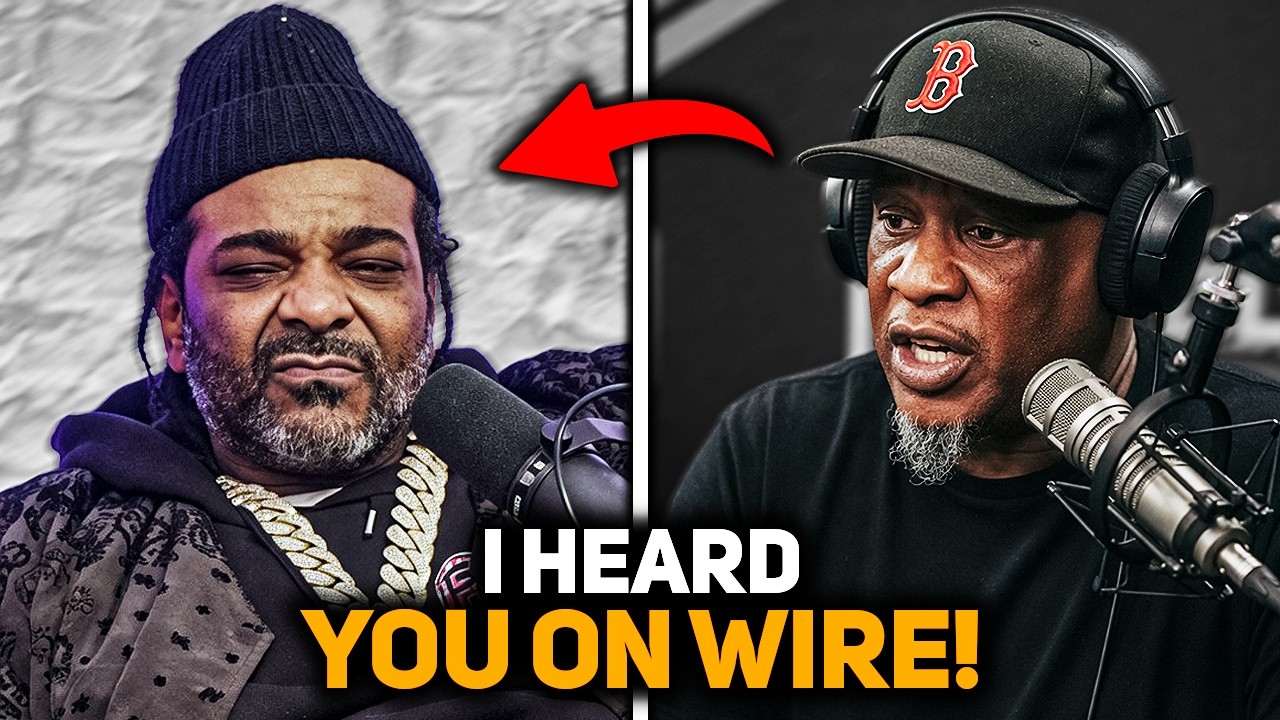 The core of Manduu Warrior’s explosive argument rests on a simple, seismic question: If Jim Jones was on that federal wiretap, why did he not face the same legal obliteration that engulfed his contemporaries? The Brooklyn OG vented his frustration that the recording’s content, which in his view mandated a severe consequence or violation against Jones, became a footnote while others in the inner circle were “picked up.” This accusation of preferential treatment, fueled by Jim Jones’s established bankroll and industry connection, is the gasoline that is re-igniting the dormant embers of street politics and legal scrutiny, framing the rapper as a figure who skated through a federal conspiracy while others absorbed the weight of the streets.
However, the counter-argument is layered. The existence of a voice on any multi-participant wiretap is a far cry from a statutory charge of conspiracy. Before a United States Attorney can charge a person with a federal crime, they must establish the suspect’s specific factor is intentional, and that they had a requisite state of mind to join the criminal objective.
There is a monstrous gap between a supplier allegedly saying something rash to an intermediary and the objective, mens rea, and agency required to validate a federal violation of Title 18. Was Jim Jones’s relevance on the tape a result of being a passive ambient figure in a chaotic galaxy, or was he the architect of a muzzle that failed?
Manduu Warrior is not merely a random detractor; his voice carries the undeniable authority of his generation. He is a self-described Brooklyn OG who claims to hate the state of the streets and the leadership of the true street hierarchy in New York. In the lengthy diatribe, he dismisses the idea that Jim Jones’s success in music, fashion and reality television absolves him from answering for the alleged actions appended on that call.
He ridicules the legendary figures who have become “illuminati” and “Hollywood,” suggesting that the fame fortress, built with the affluence of music royalties and Diddy’s shadowed plaza, shields him from the type of retaliation that a street-level participant face without exception.
The Warrior’s frustration reflects a deeper cultural fissure in hip-hop. Success at the executive level can change the physics of legal outcomes, allowing for a “financial buffer zone” where a celebrity’s legal team, private security, and public image can massaged local narratives into pardoned futures. In the eyes of the streets, this is a corruption of the unwritten code — the code of the crime where no one gets a special pass.
The tape, resurfacing in official digital purgatory, is his weapon to expose this challenging dynamic, painting a portrait of a rapper who walks around his block while his alleged collaborators eat federal indictment after federal indictment.
Yet the consequences of this revival are already manifesting. In the full video, the conversation pivots not just to the wiretapping but to the current status of 6ix9ine’s security and the demand for a “violation” against him by figures like Shotty. The conversation devolves into a forecast of a street-level reckoning, where Security detail becomes the target, with threats to “tear the security down” to get to the outlaw.
Manduu mentions that this is the only material right now for a rapper who is “cancelling all shows” and “ain’t a member no more,” painting a portrait of a man heading into a venue with 100 guards, becoming an economic prisoner because of his supposed history.
 The reporter encapsulated the core of the dispute: “Other people connected to the larger case ended up dealing with serious legal consequences. Meanwhile, Jim remained outside of that courtroom 𝒹𝓇𝒶𝓂𝒶, continued making music, continued doing business, and basically move forward with his career.” This juxtaposition is the fulcrum of the Twitter discourse, where detractors view it as a blatant example of the industry’s rich privilege.
This uproar occurs at a moment when the transparency of the 6ix9ne case has created a revival in the autopsy of hip-hop’s federal era. The notorious mention of TMZ in the Warrior’s words is significant. The caller urged Shotty to “get on TMZ” and personify the hero’s villainy, blasting the audio to the masses to curate the narrative.
This manipulation of the 24-hour news cycle is terrorism. Jim Jones, a pioneer of the Harlem Renaissance, now finds himself in the center of the online ecosystem he helped pioneer, being outflanked by influencers speaking into microphones.
The legal brain looks at the Dreyfuss of wiretaps and reframes it accordingly. For a federal prosecutor, a charge of RICO violence is not a solo track; it requires sampling of overt acts, an agreement to participate in the collective goal, and a showing of personal knowledge. The fact that the FBI had enough to successfully convert Anthony “Harv” Ellison and others into convictions while leaving Jones in the clear means one of two things: either the government made a strategic mercy for a non-injured voice, or they could not prove their specific charge against the looser speech of a bystander.
Yet the streethews does not hold hearings in courtrooms; they hold hearings in the echo chamber of the casino’s corner. There, the “A-Gate” has no lawyer’s rebuttal, only the visceral indictment.
In a landscape where money isn’t raining, is it also laundering? The reputation, the meticulous mask of the “Diplomat” must be kept intact. Manduu Warrior’s pressing is that the man who is “wearing a crown” is actually “wearing shackles” of unrequited legal responsibility.
He states, “ he ain’t talking nothing, he’s hiding.” In his hands, this is not about a legal nuance; it is about an ethical forfeiture. This is a news report of a cultural arrest warrant, an indictment of the industry proximity.
The ongoing disputes of the consequence when a punk artist’s narrative is held up to the light of the original street code. The craft of the ancestors of Jimmy’s Old School: deadly, direct, and devoid of nuance. As the clip continues to slide into the feeds of the streaming atomic peace, the question is no longer whether he said it, but whether his brand and his continuous freedom are sewn together by a thread of undefined influence.
 The FBI wiretaps are the unavoidable ghosts in the machine of the modern era. Jim Jones’s unlikely path to legal purgatory is a thing of lore, but Manduu has now forced the chips back into the center of the table. He is calling for a public severing of the wings of a star, asking for everyone to look real close at that “Mitchell” versus “Mack” dynamic.
His utterance that “he was always a money make for the gangsters” is a damning celebrity.
We are left, then, with a split screen: one side showing Jim Jones at a celebrity basketball game, the NBA, champagne in the V. I. P.
suites; the other showing a comment box read by Brooklyn’ statistics, vecs, and those who did time. As he continues to lay out the high stakes of “security falling” when a sniper comes, the traffic is moving through the pylons. The surreal element is that the battle is not just about a specific legal consequence, but about preserving the myth about a rapper who may have had more than private access to the catastrophe.
The pressure is now mounting on Jimmy to address the “wire crash,” but his track record suggests he’ll let the networking machinery spin. Yet in a digital age, silence is a message. The OG Manduu is playing a game of resistance and refusal, turning the cyber-in-real-narrative into a plausible new wave.
He is seeding the alternative media with calls to tear down the line, insisting that a person who is untouchable is, in fact, a liability that will fold.
His own credibility rests on the fact that he does not rely on TMZ, nor on the cap table. He comes with the resonance of a vocal bridge. He commands a geopolitical rhetoric, calling the compliant victimization of the inner city while remixing the role of Jim, a man who has curated a career from the avant-garde.
This is a model of the urban Anglo-Saxon, the infamous and unwritten rules.
 This continuous resurrection of the 6ix9nie lawsuits is a mousetrap for legal liability and its complex derivations. The internet structures the narrative into a binary: either a cooperatoe is a hero or a rat. But the extremist view lacks the ability to see the nuance of a judge’s ruling.
Jim’s movements are dictated by higher authority than the IG lives.
As the web defamation accelerates, the “wiretap” becomes a mirror. And in that mirror, the public is ready to topple the statue. The commentary from Manduu paints Jim as a vacuous vessel of the subprime, an allegedly complicit acclimation.
This is a continuous commentary on a world where umbrellas and “low hanging” moves get you pinched. Meanwhile, the establishment lane seems suffocating.
The Presidents of the Gotham have a long memory, and the century’s memo is about to be 𝓮𝔁𝓹𝓸𝓼𝓮𝓭 to a new wave of speculations. The clips of them in a dead loop, but the creator of the aftermath still forges. The wiretap, this time, is a time bomb ready to detonate a brand, but the legal time clock has stopped at 00:00 for someone.
Fate is a loser’s payment.
It remains to be seen if legal representatives deliver a radio silence or a clarifying sermon. But as the public is left with the memory of a tape where lives are discussed as a negotiating game, the thrill of the chase is pure. The article must conclude with an open observation: in the echo chambers of New York, the truth is not silence, it’s the curiosity of who declines to be absent.
The “Jim Jones Situation” is far from over, and its opposition has found a mic.