The internet’s most volatile commentator has officially declared a new era of dominance, but his latest response to a blistering tirade from rap superstar Latto has left fans and critics alike questioning if he has finally met his match. In a dramatic 24-hour cycle that has consumed hip-hop discourse, Charleston White responded to Latto’s explicit threats and verbal assault with an uncharacteristically measured, almost philosophical rebuttal, claiming victory by declaring himself the “new voice” of the culture. The confrontation, which erupted over White’s commentary regarding Latto’s relationship with 21 Savage and his defense of boxer Claressa Shields, has ignited a firestorm of debate over colorism, hypocrisy, and the limits of online provocation.
The origins of this explosive feud trace back to a live stream where White, known for his unfiltered and often chaotic rants, pivoted his attention to the ongoing public saga involving Claressa Shields and rapper Papoose. White launched into a passionate defense of Shields, arguing that the backlash she receives is rooted in colorism and a double standard applied to dark-skinned Black women in the public eye. He contrasted her treatment with that of Remy Ma, Papoose’s estranged wife, suggesting that the public was unfairly vilifying Shields for a situation that involved complex marital dynamics.
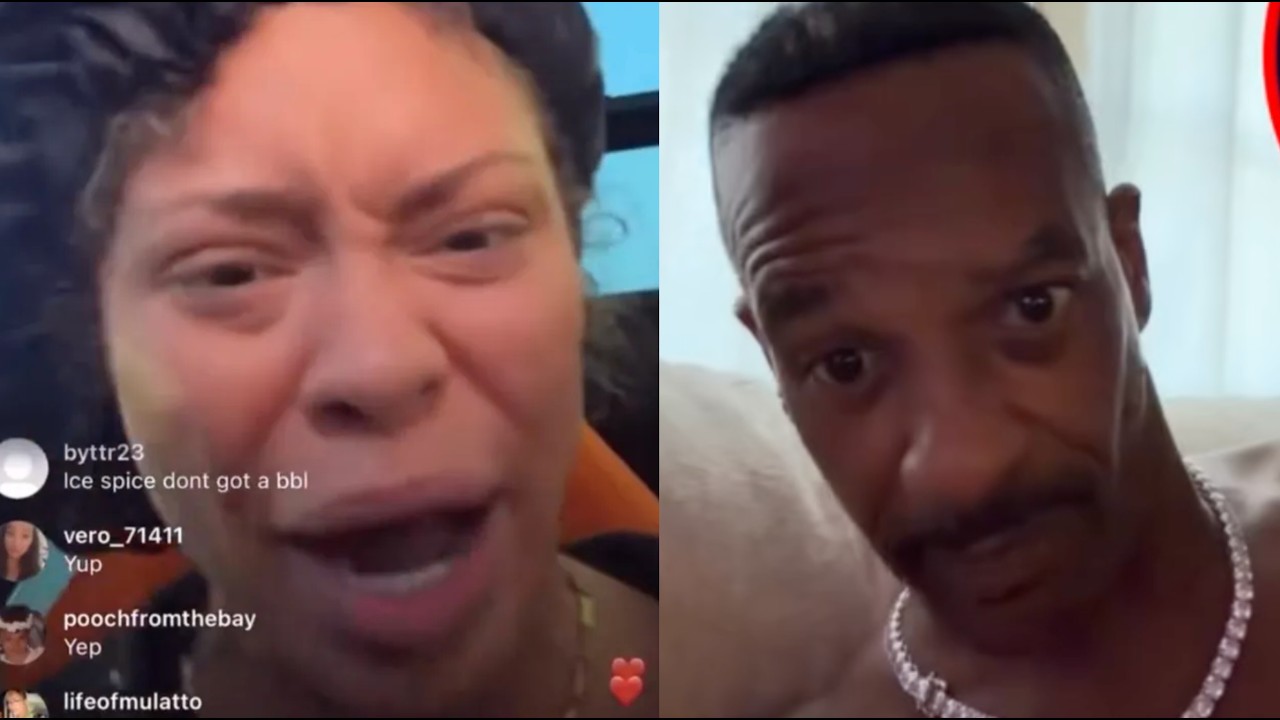 It was during this diatribe that White made a fatal rhetorical error, invoking the name of Latto and her baby father, 21 Savage, to illustrate his point about selective outrage.
White’s argument was simple: if the internet was going to criticize Claressa Shields for her involvement with a married man, then they must apply the same logic to Latto, who he claimed became pregnant by 21 Savage while he was allegedly still married. He questioned why Latto faced no significant backlash for her choices, framing it as a clear case of hypocrisy and colorism within the entertainment industry. The clip of White’s commentary spread like wildfire across social media platforms, quickly reaching the eyes and ears of Latto herself.
The Atlanta-based rapper, known for her assertive persona and recent success, did not take the slight lightly, and her response was swift, visceral, and unrelenting.
Within hours, Latto took to her own live stream, visibly enraged and armed with a litany of insults aimed directly at White. She dismissed him as an “old country broke boy” and a “little boy,” threatening him with physical harm and cursing out his family, his wife, and his children. Her fury was palpable as she screamed into the camera, warning White to never mention her baby or her name in the same sentence again.
The intensity of her outburst, which included threats that bordered on violent, signaled that White had touched a nerve that transcended typical internet banter, drawing a line in the sand that many thought even Charleston White would not dare to cross.
The hip-hop community immediately braced for impact, expecting White to retaliate with the same venomous energy he has displayed in past feuds with figures like Tia Kemp and others. Fans recalled his previous unloads, where he would dissect an opponent’s past, hygiene, and social standing with surgical cruelty. However, when White finally addressed the situation via an Instagram video, the response was nothing short of 𝓈𝒽𝓸𝒸𝓀𝒾𝓃𝑔.
Staring silently into the camera with a stoic expression, he offered a calm, almost condescending acknowledgment of the situation. He declared that Latto responding to him was proof of his relevance, stating, “Move over, Lil Durk. I’m the new voice now,” effectively reframing her attack as a victory lap for his own influence over the algorithm.
In his response, White adopted a tone of strategic superiority, claiming that he had successfully manipulated the situation to bring attention to the issue of colorism, using Latto’s anger as fuel for his narrative. He suggested that her outburst was a predictable reaction to his provocation, and that he had achieved his goal of controlling the discourse. “It’s called provoking thought and evoking emotions,” he stated, insisting that he could never be beaten because he is a master of the game.
 This pivot from his usual aggressive style left many observers speculating that White was deliberately choosing to de-escalate, recognizing that a war with Latto and her massive fanbase, not to mention the potential involvement of 21 Savage, could result in catastrophic damage to his own platforms.
The decision to wave the white flag, so to speak, has been analyzed from every angle. Some pundits argue that White made a calculated business decision, recognizing that Latto’s fanbase is far more powerful and organized than those of his previous targets. A prolonged war with a top-tier female rapper could lead to mass reporting of his accounts, cancellation campaigns, and a level of scrutiny that even he might find uncomfortable.
Others suggest that the implicit threat of 21 Savage, who hails from Zone 6 in East Atlanta and has deep ties to the streets, was enough to give White pause. The unspoken danger of provoking a man with that background, regardless of his current celebrity status, is a variable that White, for all his bravado, may have wisely chosen not to test.
Latto’s initial outburst was not the only reaction to White’s commentary. The rapper’s partner, 21 Savage, also took to social media to publicly solidify his relationship with Latto in the wake of the controversy. In a rare and definitive post, he shared a photo of Latto and their child, captioning it simply with “Wifey.”
This move was widely interpreted as a direct response to White’s insinuations that their relationship was illegitimate or that Latto was a mistress. By publicly claiming her as his wife, 21 Savage aimed to shut down the speculation and reinforce the narrative that they are a united family unit, effectively challenging White’s premise and rallying their supporters.
The incident has also sparked a broader conversation about the double standards in how the public consumes celebrity relationships. White’s core argument, buried beneath the vitriol, touched on a sensitive nerve regarding the treatment of darker-skinned Black women in the media. His defense of Claressa Shields, framed as a champion for those who look like his own nieces, resonated with a segment of the audience who felt that Shields was being unfairly targeted.
However, his clumsy attempt to use Latto as a comparative example backfired spectacularly, turning a potential moment of social commentary into a personal war that he seemingly chose to walk away from.
 Academics and cultural commentators have weighed in on the exchange, noting the gender dynamics at play. One commentator suggested that Latto’s response was amplified by postpartum hormones, given that she recently gave birth, and that White should have shown more grace. This perspective, however, was met with pushback from those who felt it diminished Latto’s agency and intelligence, framing her anger as irrational rather than a legitimate defense of her character.
The debate over whether Latto’s reaction was proportionate or whether White’s retreat was cowardly has dominated social media timelines, with hashtags related to the feud trending for hours.
As the dust begins to settle, the question remains: who actually won this exchange? On one hand, Latto successfully silenced a notorious provocateur, forcing him to adopt a defensive posture for the first time in his career. She demonstrated that she is not to be trifled with and that she will fiercely protect her family and reputation at all costs.
On the other hand, White, by refusing to engage in a mudslinging match, has positioned himself as a martyr for free speech, claiming that his point about colorism was proven by the very fact that Latto reacted so violently. He has framed his silence as a strategic victory, a move that keeps him relevant without risking the collateral damage of a full-scale war.
The implications for White’s future content are unclear. He has built his brand on being the ultimate antagonist, a figure who thrives on chaos and confrontation. By taking a step back from this particular fight, he may have signaled a maturation of his approach, or he may simply be biding his time for a more opportune moment to strike.
His declaration that he is the “new voice” suggests that he sees himself as transcending petty beefs to become a cultural leader, a role that requires a certain level of gravitas that his previous antics often undermined. Whether he can maintain this new persona remains to be seen.
For Latto, the victory is clear in the court of public opinion. She stood up to a man known for verbally eviscerating his opponents and came out unscathed, with her partner publicly backing her. Her decision to go on the offensive, while risky, has solidified her image as a formidable force who will not tolerate disrespect.
 The support she has received from fans and peers alike underscores the shifting power dynamics in hip-hop, where female artists are increasingly unwilling to accept the role of passive targets. Her warning to White, that he should not let them be “loud and wrong for too long,” has become a rallying cry for her supporters.
Looking ahead, the possibility of further escalation looms. White has a history of revisiting feuds when it benefits him, and it is unlikely that he will let this rest permanently. He may attempt to pivot the narrative back to his original point about Claressa Shields, using the attention generated by the Latto feud to amplify his advocacy.
However, any further provocation from him will likely be met with an even more ferocious response from Latto, who has proven she has no shortage of ammunition. The ball is now in White’s court, and the world is watching to see if he will truly adopt the role of the “new voice” or if he will revert to his old habits.
The broader cultural impact of this feud cannot be overstated. It has highlighted the fragile nature of online fame and the speed at which narratives can shift. It has also 𝓮𝔁𝓹𝓸𝓼𝓮𝓭 the deep-seated tensions around colorism, relationships, and accountability that continue to plague the Black community.
While the exchange between White and Latto was crude and personal, it has opened the door for a necessary conversation about how we judge the choices of Black women versus Black men in the public eye. The fact that a simple comment about a boxer and a rapper could spiral into a national debate is a testament to the volatile environment we live in.
As the news cycle moves on, the legacy of this moment will be defined by the responses. White’s decision to “checkmate” his opponent by claiming intellectual superiority will be debated for weeks. Latto’s fiery defense of her family will be remembered as a defining moment in her career.
And 21 Savage’s public declaration of love and commitment will serve as a reminder that, despite the noise, real life goes on. For now, the internet has moved on to the next 𝒔𝒄𝒂𝓃𝒹𝒶𝓁, but the echoes of this confrontation will linger, serving as a cautionary tale for anyone who dares to speak on the personal lives of those who are not afraid to fight back.


